Four Oracle options used to force automatic minor version upgrades on. They no longer do. The capability is genuinely useful and the thing worth noticing is what moved: not the upgrade, which still has to happen, but who is responsible for it.
“Amazon Relational Database Service (Amazon RDS) for Oracle now lets you turn off automatic minor version upgrades on new and existing DB instances that use the JVM, Spatial, Locator, or OLAP option.”
Executive summary
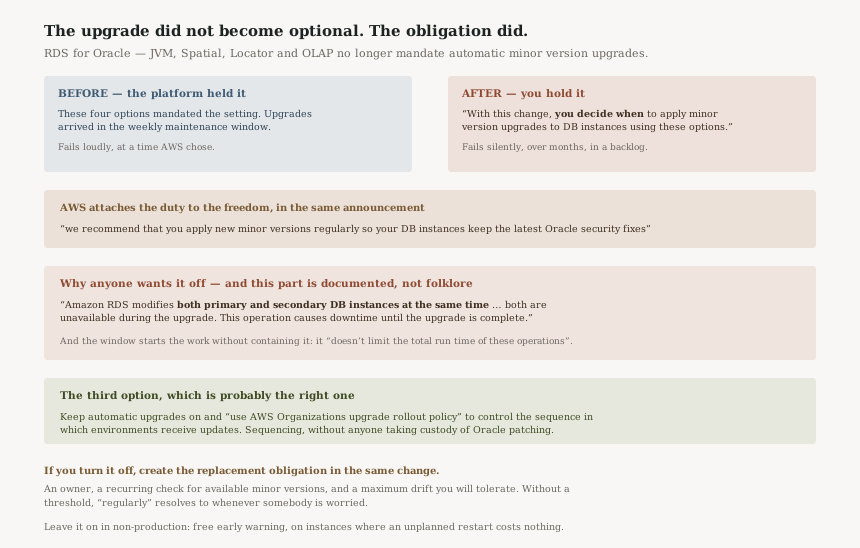
Those four options previously mandated the setting. Now: “With this change, you decide when to apply minor version upgrades to DB instances using these options.”
AWS attaches the consequence in the same breath, which is the sentence to carry into the change ticket: “If you turn off automatic minor version upgrades, we recommend that you apply new minor versions regularly so your DB instances keep the latest Oracle security fixes.”
It is available “in all commercial AWS Regions and the AWS GovCloud (US) Regions where Amazon RDS for Oracle is available”, with no pricing or licensing change stated.
What changed
Nothing about the upgrades themselves. What changed is that a platform-enforced obligation became a customer-held one, for four specific options and nothing else.
That distinction matters because a mandate and a recommendation fail differently. A mandate fails loudly, at a time AWS chose, in your maintenance window. A recommendation fails silently, over months, in a backlog. Nothing in the console will go red because you have not applied a minor version in a year.
Architecture
Why anyone wants this, and the reason is documented
The usual assumption is that Multi-AZ absorbs a patch. For an operating system update it largely does — RDS patches the standby, promotes it, then patches the old primary. For an engine upgrade it does not:
“If you upgrade the database engine for your DB instance in a Multi-AZ deployment, Amazon RDS modifies both primary and secondary DB instances at the same time. In this case, both the primary and secondary DB instances in the Multi-AZ deployment are unavailable during the upgrade. This operation causes downtime until the upgrade is complete.”
So an automatic minor version upgrade on a Multi-AZ Oracle instance is a planned outage whose timing you did not pick, bounded by a window that does not bound it: “The maintenance window determines when pending operations start, but doesn’t limit the total run time of these operations.” For a large Oracle estate with the JVM or Spatial options loaded, wanting control over that date is an entirely reasonable position, and until now it was not available.
The middle path AWS names, which is probably the right answer
The announcement points at a third option rather than a binary: teams that would rather keep automatic upgrades enabled can “use AWS Organizations upgrade rollout policy” to control the sequence in which environments receive updates.
That is the shape most estates actually want. The problem was never that upgrades happen; it was that development and production received them in no particular order. Sequencing solves that without anybody taking custody of Oracle patching by hand.
What the setting does and does not hold back
The same flag is the documented way to stop a scheduled action: “To cancel a maintenance action, modify the DB instance and disable Auto minor version upgrade.”
It is not a general exemption from change. AWS documents a category of upgrade that arrives regardless of how you schedule: “If you repeatedly modify your DB instance maintenance window to avoid a pending mandatory upgrade, Amazon RDS can still apply the upgrade outside of your preferred maintenance window after the mandatory apply date has passed”, and that “applies to all forced upgrades, including engine version deprecations and instance type deprecation campaigns”.
That paragraph is about the maintenance window rather than about this flag, so read it as the surrounding weather and not as a claim about what disabling the setting does. The useful point stands either way: deferring minor versions does not defer a deprecation, and an instance left far behind meets its end-of-support date with more to do, not less.
Business value
For regulated Oracle workloads this removes a real planning problem. A database that could be upgraded without notice inside a 30-minute weekly window is hard to reconcile with a change calendar that requires an approved window and a tested rollback. Being able to schedule the upgrade is what lets the database join the same release process as everything around it.
It also narrows a gap between RDS for Oracle and the rest of the engine family, where the setting has long been yours to choose. The four options were the exception, and exceptions cost teams more than they appear to — a fleet-wide standard that four instances cannot follow is a standard with a permanent footnote.
Security considerations
The recommendation is the whole security story and AWS states it plainly: “we recommend that you apply new minor versions regularly so your DB instances keep the latest Oracle security fixes.” Oracle minor versions are where Critical Patch Update content lands. Turning the setting off puts a clock on your own process rather than removing the clock.
Know what you are declining. “Required patching is automatically scheduled only for patches that are related to security and instance reliability.” That is the category this setting governs — not cosmetic releases.
It can become a compliance question rather than an engineering one. “Staying current on all optional and mandatory updates might be required to meet various compliance obligations.” Where an auditor expects current patch levels, the evidence after this change is your own upgrade record rather than the platform's behaviour.
Cost considerations
No pricing or licensing change is stated in the announcement. The cost is operational: somebody now owns tracking available minor versions, scheduling them, and carrying the risk that a deferred upgrade becomes a larger one. That labour is real and it is not on any invoice, which is exactly why it is easy to accept without deciding to.
Operational considerations
The window starts the work; it does not contain it. “Most maintenance events also complete during the 30-minute maintenance window, although larger maintenance events may take more than 30 minutes to complete.” Planning your own upgrade means planning for an overrun, which is one of the arguments for doing it deliberately.
Decide per environment, not per fleet. The case for turning it off in production is strong and the case in development is weak — and leaving it on in development is what surfaces a bad minor version before production meets it.
Tradeoffs
| What you gain | What it costs |
|---|---|
| The upgrade happens on a date you chose and tested | A date somebody has to choose, every time, forever |
| Multi-AZ engine-upgrade downtime lands in a planned outage | Nothing turns red when the gap between your version and current grows |
| Oracle joins the same change process as the rest of the estate | Patch currency becomes evidence you produce rather than behaviour you inherit |
| No pricing or licensing change | The new work has no line item, so it competes badly for attention |
Implementation guidance
Try the rollout policy before the off switch. If the real complaint is sequencing rather than timing, AWS's own suggestion — “use AWS Organizations upgrade rollout policy” — gets you staged environments without anyone taking ownership of Oracle patching.
If you do turn it off, create the replacement obligation in the same change. A recurring item that checks available minor versions and schedules one, with an owner. The announcement's recommendation is only a recommendation until something in your process enforces it.
Set a maximum drift you will tolerate — some number of minor versions or months behind current — and alarm on it. Without a threshold, “regularly” resolves to whenever somebody is worried.
Leave it on in non-production. Free early warning, on instances where an unplanned restart costs nothing.
Rehearse the Multi-AZ downtime once. Both nodes go at once for an engine upgrade; measure how long your largest instance actually takes before the outage is a real one.
Best practices
Treat the setting as an environment-level decision with a recorded reason, not an instance-level convenience. An instance that has it off because somebody was mid-incident eighteen months ago is the failure case.
Keep an inventory of which instances have it disabled. After this change that set can grow quietly, and it is precisely the set an auditor will ask about.
Pair the deferral with a plan for end of support. Deferring minor versions does not move a deprecation date, and a long-deferred instance has further to travel when that date arrives.
Who should adopt this and when
Adopt now if you run Multi-AZ Oracle with any of these four options under a change process that requires approved windows. This removes a genuine conflict, and the downtime characteristic that motivates it is documented rather than folklore.
Prefer the rollout policy if your complaint is that environments upgrade in the wrong order. That is a sequencing problem and it has a sequencing answer.
Leave it alone if you have no owner for Oracle patch currency. Automatic upgrades with occasional inconvenient timing beat manual upgrades that do not happen, and this change makes the second outcome available for the first time.
Key takeaways
Four options stopped mandating the setting — JVM, Spatial, Locator and OLAP — on new and existing instances, in all commercial and GovCloud (US) Regions.
AWS pairs the freedom with the duty in the same announcement. Apply new minor versions regularly “so your DB instances keep the latest Oracle security fixes”.
The documented reason to want it is Multi-AZ. An engine upgrade takes both nodes at once and “causes downtime until the upgrade is complete”.
There is a third option. The Organizations upgrade rollout policy sequences environments without anyone taking custody of the patching.
Official AWS references
- Amazon RDS for Oracle no longer requires automatic minor version upgrades for JVM, Spatial, Locator, and OLAP options — the four options affected, the statement that you now decide when to apply minor version upgrades, the security recommendation that accompanies turning it off, the Organizations upgrade rollout policy as an alternative, and the Region availability
- Maintaining a DB instance — the Multi-AZ engine upgrade taking both instances at once and causing downtime, required patching being scheduled only for security and instance reliability, disabling auto minor version upgrade as the way to cancel a maintenance action, forced upgrades surviving maintenance-window changes, the 30-minute weekly window and the note that it does not bound total run time, and the compliance note on staying current
- Upgrading the RDS for Oracle DB engine — further reading on Oracle-specific upgrade paths and prerequisites; no claims in this post are drawn from it
Comments