Business Challenge
The previous post built an allocation model: tags for what can be labelled, backfill for what was labelled late, split charge rules for what has no single owner. It works on the numbers that reach it. This post is about the layer underneath, which has already moved the money by the time those numbers exist.
A platform team buys a three-year Compute Savings Plan from the shared services account, because that is where the commitment budget lives and where finance wanted the purchase recorded. The following month, shared services shows almost none of the benefit. A product account nobody consulted shows most of it. Nothing is wrong, nobody misconfigured anything, and the report is accurate.
It happened because a commitment is not attached to the account that bought it. It is applied, hour by hour, to whichever eligible usage saves the most — owner first, then everyone else.
The rule is explicit. Savings Plans “are applied to your highest savings percentage first”, with ties broken by “the first usage with the lowest Savings Plans rate”. Across an organisation, “accounts with the largest calculated savings are prioritized”.
So the benefit follows the shape of usage, not the shape of your org chart. Two accounts running different eligible workloads may receive very different shares of the same commitment, because AWS prioritises usage according to calculated savings percentage — not organisational ownership, and not raw workload price. The split changes as their workloads change.
FixStop treating the purchase account as the beneficiary. It is the Savings Plans owner account, but it is not necessarily the account that receives most of the discount benefit.
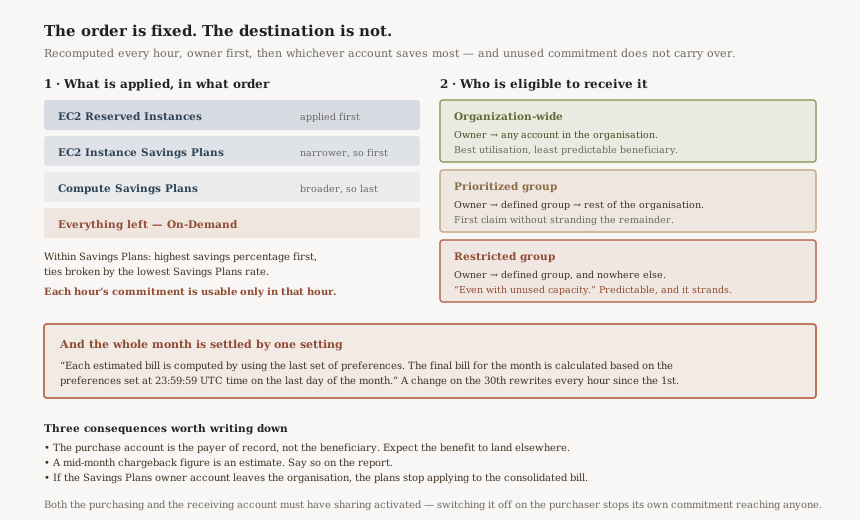
This is the detail that turns a reporting inconvenience into a reporting trap. AWS: “each estimated bill is computed by using the last set of preferences. The final bill for the month is calculated based on the preferences set at 23:59:59 UTC time on the last day of the month.”
A sharing preference changed on the 30th does not apply from the 30th. It applies to the whole month. Every hour since the 1st is recomputed against it, so a chargeback figure circulated on the 15th can be wrong by month end without anybody touching a workload.
FixTreat mid-month commitment allocation as an estimate, and say so on the report. Freeze sharing preferences during the month if finance needs stability.
“If a Savings Plans owner account leaves the organization, Savings Plans no longer apply to the consolidated bill.” The commitment is still paid for. It simply stops discounting everyone else.
That makes an account migration — a divestment, a reorganisation, moving an account between organisations — a financial event as well as an administrative one, and it is rarely on the checklist for either.
FixKnow which account owns each commitment, and make owner-account moves a change that requires sign-off from whoever bought it.
Architecture
Two mechanisms decide where a discount lands: the order commitments are applied in, and the sharing mode that scopes who is eligible.
The application order
Reserved Instances are consumed before Savings Plans. Then EC2 Instance Savings Plans, which are narrower, before Compute Savings Plans, which AWS applies later precisely because they have broader applicability — spending the specific commitment first leaves the flexible one available for whatever is left. Anything still uncovered is billed On-Demand.
Inside that, the commitment is spent on the highest discount percentage available. AWS's own
worked example has an r5.4xlarge at $1.00 On-Demand against $0.70 under
a Compute Savings Plan — a 30% saving — and Fargate at 25%, so the r5 usage is covered
first even if the Fargate usage belongs to a different team.
And none of it banks: “each hour's commitment can only be used within that hour and cannot be carried over”. An idle hour is simply spent. That is the real argument for sharing being on — not fairness, but that unused commitment is money already gone.
The three sharing modes
Organization-wide
Owner first, then remaining benefit is available to any account in the organisation. AWS's framing: it maximizes overall commitment discount rates. Best utilisation, least predictable allocation.
Prioritized group
Owner first, then a defined group, then the rest of the organisation. A middle position: a business unit gets first refusal on what it paid for, and nothing is wasted if it does not use it all.
Restricted group
Owner first, then the group, and nowhere else — AWS notes no sharing occurs outside designated groups even with unused capacity. Predictable, and it can leave commitment unspent.
Per-account deactivation
Sharing can be switched off for individual accounts. Both the purchasing account and the receiving account must have it on for a discount to flow between them.
Groups are defined with AWS Cost Categories, and the rules are narrow: each account can belong to only one sharing group, the payer account cannot be part of a sharing group, and only the Accounts dimension may be used. If you have already built Cost Categories for the allocation model in the previous post, they are probably not reusable here without checking those conditions first.
Why This Architecture Holds Up
Utilisation and attribution are in direct tension
The three modes are a single dial between two things you cannot have at once. Organization-wide sharing maximises the chance a commitment is fully consumed, and makes the beneficiary unpredictable. Restricted group sharing makes the beneficiary predictable, and AWS says plainly it “might result in some underutilized commitments”.
There is no configuration that gives both, and the choice is a finance decision rather than an engineering one. The engineering contribution is making the trade explicit: restricted sharing has a price, and that price is unspent commitment on a plan already paid for.
AWS states it directly: “deactivating Reserved Instance and Savings Plans discount sharing can result in higher monthly bills”. It is sometimes still the right call — a regulated subsidiary that cannot receive cross-entity benefit, an account being prepared for divestment — but it should be taken as a decision with a number attached, not as tidying.
What this does to the allocation model from #49
The previous post's mechanisms all operate on costs that already exist. Commitment discounts operate before that: they decide what the cost is for a given account-hour. So a tag cannot attribute a discount, and a split charge rule cannot redistribute one, because by the time either runs the money has already moved.
That is why commitment reporting usually needs its own treatment rather than folding into the tag model — and why the honest version of a chargeback statement separates usage attributed by tag from discount received by commitment sharing. They answer different questions and only one of them is under the receiving team's control.
Key Architecture Decisions
| Decision | Choice | Reasoning |
|---|---|---|
| Default sharing mode | Organization-wide, unless there is a reason not to | Unused commitment does not carry to the next hour. Maximum utilisation is the default that wastes least. |
| When predictability matters more | Prioritized group before restricted | It gives a business unit first claim on what it bought without stranding the remainder, which restricted mode can. |
| Purchase account | Treated as commitment owner, not guaranteed beneficiary | Owner is served first, but the rest follows savings percentage. Expect the benefit to land elsewhere. |
| Mid-month reporting | Labelled as an estimate | The final bill uses the preferences in force at 23:59:59 UTC on the last day, applied to the whole month. |
| Owner account moves | Gated, with the commitment owner consulted | If the owner leaves the organisation, the Savings Plans stop applying to the consolidated bill entirely. |
| Chargeback statement | Usage and commitment benefit reported separately | One is attributable to the team, the other is an artefact of organisation-wide optimisation. Merging them makes both unarguable. |
The sequencing detail that catches people out
Both sides must be switched on. AWS states that both purchasing and benefit receiving accounts must have sharing activated to share discounts, and separately that the Savings Plans owner account “must be active in the RI and Savings Plans discount sharing preferences” for the discount to reach other accounts at all.
That produces a quiet failure mode. Deactivating sharing on the purchasing account — perhaps to stop it receiving other teams' discounts — also stops its own commitment from benefiting anybody else. The plan keeps billing and the discount stops flowing, and nothing announces it.
Closing Thought
Fifty posts in, the recurring finding has not changed much: most cost and security controls are real, correctly configured, and answering a narrower question than the sentence used to describe them. Commitment sharing is the purest example yet, because here the gap is not in the tooling at all. AWS documents the behaviour precisely. It is just that almost nobody reads the application order before buying, and the mental model — we bought it, so we have it — is wrong in a way that produces a correct report nobody believes.
The useful reframe is to stop thinking of a commitment as an asset held by an account and start thinking of it as a discount schedule applied to the organisation, hour by hour, in a fixed order, finalised at the end of the month. Every confusing thing about it follows from that sentence, and so does every sensible decision: why sharing should usually be on, why restricted mode costs something real, and why a mid-month chargeback number is an estimate.
Cost & Governance — budgets and anomaly detection: why a budget alert almost always arrives after the money is spent, what anomaly detection actually models, and the difference between a control that warns you and one that stops you.
Official AWS Reference
- Understanding how Savings Plans apply to your usage — the application order and five worked scenarios
- Reserved Instances and Savings Plans discount sharing — the three sharing modes and the month-end preference rule
- Understanding consolidated bills
- What are Savings Plans
- Splitting charges within cost categories — the allocation model this sits underneath
Comments