Executive summary
Elastic Beanstalk has introduced Cluster Mode, described as “a new deployment mode that lets you run and manage multiple applications on shared infrastructure in your account.”
The mechanism is the interesting part: it “runs multiple applications on pooled infrastructure in your account, powered by Amazon EKS, instead of a dedicated environment per application.”
That is a genuine change of shape for a service whose defining characteristic was a dedicated environment per workload. Beanstalk has always been the silo model with the operational detail hidden. Cluster Mode is the pooled model, with Kubernetes underneath and the operational detail still hidden — which is either the best of both or a new set of things you cannot see, depending on what goes wrong.
What changed
A second deployment mode, not a replacement. Standard Mode remains, and the announcement is specific that it “continues to support all currently available platforms, including .NET, Node.js, and Python.”
That sentence is worth reading carefully rather than skimming. It reassures about Standard Mode's platform coverage, and the announcement does not make the same statement about Cluster Mode. It may simply be reassurance for existing users; it may indicate a narrower platform set on the new mode. The announcement does not say, and the Cluster Mode documentation page is not yet published — so if your platform matters, verify it before planning a migration rather than inferring it from that sentence in either direction.
A managed feature set that reads as modern defaults. Cluster Mode “supports event-driven autoscaling, OpenTelemetry-based observability to Amazon CloudWatch and third-party providers, AWS Secrets Manager integration, and HTTPS by default via AWS Certificate Manager.” OpenTelemetry to third-party providers is notable — it is not a CloudWatch-only story.
Broad availability, unchanged compliance posture. All commercial Regions where Beanstalk exists, and Beanstalk remains “HIPAA eligible and in scope for programs including PCI DSS, SOC, FedRAMP, and IRAP.”
Architecture
To see why this matters you have to look at what an environment costs you structurally, not just financially.
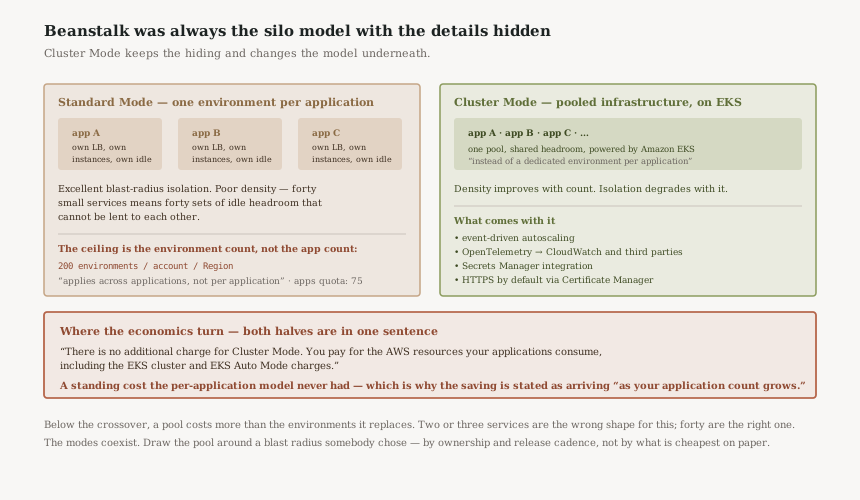
In Standard Mode every application carries its own environment: its own load balancer, its own instances, its own idle headroom. Forty small services means forty sets of spare capacity that cannot be lent to each other. That is the classic silo trade — excellent blast-radius isolation, poor density.
The structural ceiling is sharper than the cost one, and it is in the quotas. The default is 200 environments per account per Region, and the wording matters: “The limit applies across applications, not per application.” A platform running production and staging for each service spends two environments per application out of that shared 200. The applications quota is 75 per account per Region, also adjustable.
So the environment count, not the application count, is what a growing estate runs into first. Pooling removes that as the binding constraint, because the density is no longer expressed one environment at a time.
Business value
The stated benefit is narrower than “cheaper”, and the precision is worth preserving: Cluster Mode “can lower your per-application compute cost as your applications scale or your application count grows.”
Per-application, and conditional on growth. That is the honest shape of every pooling argument: shared headroom amortises across tenants, so the more tenants there are, the better the amortisation. It is the same economics as the multi-tenancy decision generally — density improves with scale, and isolation degrades with it.
The second value is organisational rather than financial. A team that wanted Kubernetes-shaped capabilities — event-driven autoscaling, OpenTelemetry, per-application secrets — previously had to leave Beanstalk to get them. This is those capabilities without the migration, which for a certain kind of estate is worth more than the compute saving.
Security considerations
No change to Beanstalk's compliance posture is stated, and the announcement reaffirms HIPAA eligibility and PCI DSS, SOC, FedRAMP and IRAP scope.
The consideration is isolation rather than compliance. A dedicated environment per application is a strong boundary almost by accident — separate instances, separate load balancer, separate failure domain. Pooling onto shared EKS infrastructure replaces that with Kubernetes-level separation, which is real but different, and which most Beanstalk users have not had to reason about before precisely because Beanstalk existed to hide it.
That is not an argument against Cluster Mode. It is an argument for deciding deliberately which applications belong in a pool. An application with a distinct regulatory scope, or one whose compromise should not be adjacent to the others, is the case the silo model was serving even if nobody chose it for that reason. HTTPS by default via ACM and Secrets Manager integration are both genuine improvements on what a hand-rolled Standard Mode environment typically had.
Cost considerations
The pricing sentence contains the whole trade: “There is no additional charge for Cluster Mode. You pay for the AWS resources your applications consume, including the EKS cluster and EKS Auto Mode charges.”
Both halves matter. Beanstalk is not charging for the feature, which is consistent with how it has always been priced. But the bill now includes an EKS cluster, and a cluster is a standing resource rather than a per-application one. That is a fixed component the per-application model did not have.
Which explains why AWS phrased the benefit as it did. The saving arrives “as your applications scale or your application count grows” — because the fixed cost has to be amortised before pooling wins. Below some number of applications, a pool is more expensive than the environments it replaces. Two or three small services are exactly the wrong shape for this; forty are exactly the right one.
Nobody can tell you the crossover point from the announcement, and it depends on your instance sizes and idle ratios. It is a calculation worth doing with real numbers before migrating, and the inputs are all things you already have.
Operational considerations
There is now Kubernetes in your Beanstalk. That is the sentence to sit with. Beanstalk's proposition was that you did not need to know what was underneath. Cluster Mode keeps that proposition and changes the answer, and the two are in tension the moment something behaves unexpectedly. Debugging a pooled workload eventually means reasoning about scheduling and resource limits even if you never type kubectl.
The blast radius changed and nothing will announce it. In Standard Mode a bad deployment damages one environment. In a pool it shares infrastructure with its neighbours. Fine for a set of services owned by one team; a different conversation for applications owned by different teams with different release cadences.
Check your platform before planning. As above — the announcement states platform support for Standard Mode and not for Cluster Mode, and the documentation is not yet published. That is the first question to answer, because it determines whether any of the rest applies to you.
Quota relief is real but re-read the quotas. If you adopted Cluster Mode to escape the 200-environment ceiling, note that applications, application versions and configuration templates have their own limits — 75, 1,000 and 2,000 respectively, all per account per Region. Moving the binding constraint is not the same as removing it.
Tradeoffs
Density against isolation, stated plainly. This is the pooling trade in its clearest form. You gain shared headroom and lose a per-application failure boundary. Neither is universally right, and the correct answer differs between applications within the same estate — which is the argument for running both modes rather than migrating wholesale.
Fixed cost against marginal cost. Pooling converts many small variable costs into one standing cost plus smaller marginal ones. Better at volume, worse below the crossover, and the crossover is yours to compute.
Managed simplicity against a deeper stack. The feature list is genuinely better than what most Standard Mode environments have. It is also more machinery under an abstraction that exists to let you ignore machinery. That is a good trade while things work and a longer incident when they do not.
Implementation guidance
Confirm platform support first. It is the gating question and the announcement does not answer it for Cluster Mode. Everything else is wasted effort until it is settled.
Count your environments, not your applications. The quota that binds is 200 environments across all applications. If you are near it, that is the strongest concrete argument for Cluster Mode and it is a number you can look up today.
Do the crossover arithmetic with your own idle ratio. Take your current per-environment compute, multiply by the number of environments, and compare against a pool sized for aggregate peak plus the standing EKS cost. If the answer is close, you are below the point where pooling pays.
Pool by ownership and release cadence, not by convenience. Applications sharing infrastructure should share a team or at least a change process. The cheapest pool on paper is the whole estate; the one that survives an incident review is the one drawn around a blast radius somebody chose.
Best practices
Run both modes. Standard Mode for the application whose isolation is worth paying for; Cluster Mode for the long tail of small services where per-application environments are pure overhead. The modes coexist, and treating this as an either/or discards the point.
Write down why each application is where it is. The isolation decision is invisible once made, and the next person will see only a mode setting. One line of reasoning next to it is what keeps the estate coherent.
Use the observability you now get. OpenTelemetry to CloudWatch or a third-party provider is a meaningful upgrade over default Beanstalk health reporting, and it is the thing that will make a pooled incident tractable.
Who should adopt this
Cluster Mode is available now in all commercial Regions where Beanstalk is, and nothing changes for existing environments unless you choose it.
It is worth evaluating if you run many small Beanstalk applications, if you are approaching the environment quota, or if you have been considering leaving Beanstalk for EKS to get autoscaling and OpenTelemetry. It is worth skipping if you run a handful of applications — the standing cluster cost will not amortise — or if per-application isolation is a requirement rather than a side effect.
Key takeaways
- Cluster Mode runs multiple applications on pooled infrastructure powered by Amazon EKS, instead of a dedicated environment per application.
- Standard Mode remains and the two coexist; this is an additional mode, not a migration.
- The binding constraint for a growing estate is usually the 200-environment quota, which applies across applications rather than per application.
- No charge for Cluster Mode itself, but you pay for the EKS cluster and EKS Auto Mode — a fixed cost the per-application model did not have.
- AWS states the saving arrives as application count grows, which is the same as saying pooling loses below a crossover you have to compute.
- Platform support is stated for Standard Mode and not for Cluster Mode, and the Cluster Mode documentation is not yet published. Verify before planning.
- Pooling trades a per-application failure boundary for shared headroom. Draw the pool around a blast radius somebody chose.
Comments