This is a useful launch: your existing CloudWatch metrics become PromQL-queryable without re-instrumenting anything, and the basic level costs nothing. The thing to know before you enable it is that the basic level is not what you get by default. The charged level is.
“Resource tag enrichment is the default, and it's charged. If you want only
basic enrichment, explicitly set” EnableTagEnrichment to false.
Executive summary
The announcement is “Amazon CloudWatch announces basic OpenTelemetry enrichment at no additional cost”, and what it does is translate the metrics AWS already publishes into a shape PromQL can read: “After you enable OTel enrichment, metrics that contain a resource identifier dimension (for example, EC2 CPUUtilization with an InstanceId dimension) are converted to OTel data points and become queryable using PromQL.”
Nothing is taken away while this happens: “The original classic CloudWatch metric is not modified and remains available through existing CloudWatch APIs.”
What the announcement does not mention is that there are two levels — “OTel enrichment has two levels. You choose the level when you start enrichment, and you can change it at any time” — and that the one the announcement is about is the one you have to ask for.
What changed
| Level | What it adds | Cost |
|---|---|---|
| Basic enrichment | Resource ARN (cloud.resource_id), cloud provider, Region, account ID, and an instrumentation scope naming the source service. Original dimensions preserved as data point attributes. |
No additional charge |
| Resource tag enrichment | Everything above, plus each resource's AWS tags as PromQL labels | Charged as OTel Vended Metric Enrichment |
Scope is narrower than “your CloudWatch metrics”: “OTel enrichment applies only to classic vended metrics. These are the metrics that AWS services publish to CloudWatch in the classic namespace and dimension model.” And it is not needed everywhere: “Some AWS services also send vended metrics natively in OTel format to the OTLP endpoint. You don't need OTel enrichment to query those metrics through PromQL.”
Architecture
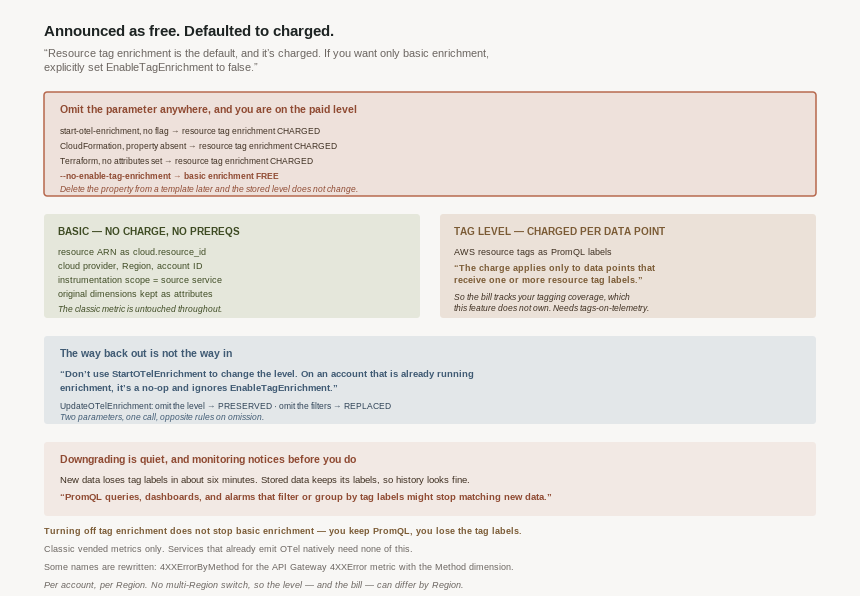
The default is the charged level, in three places
This is the whole finding, and it is consistent across every interface:
| If you | You get |
|---|---|
Omit EnableTagEnrichment on StartOTelEnrichment | Resource tag enrichment — charged |
| Omit the property on the CloudFormation resource | Resource tag enrichment — charged |
| Declare the Terraform resource with no attributes | Resource tag enrichment — charged |
Set it to false explicitly | Basic enrichment — free |
The API behaviour is stated plainly: “The EnableTagEnrichment parameter sets the level. Set it to false for basic enrichment, or true for resource tag enrichment. If you omit it when you start enrichment, CloudWatch uses resource tag enrichment.” And for infrastructure as code: “If you omit EnableTagEnrichment when you create the resource, the default is true. If you later remove EnableTagEnrichment from the template, the stored level doesn't change.”
That second sentence is worth a second read. Removing the property from a template does not revert the
level — it leaves whatever is stored. So a template that once set true and has
since had the line deleted is still running the charged level, and the template no longer says so.
The free level is the one with no prerequisites: “Basic enrichment has no prerequisites. Before you start resource tag enrichment, you must ” enable resource tags on telemetry for the account. The console will do that for you, which means clicking the resource-tag toggle enables two things rather than one.
What you are charged for is narrower than the level
The billing unit is not the account or the metric, it is the data point that actually received a label: “The charge applies only to data points that receive one or more resource tag labels. When a metric matches no AWS resource tags, for any reason, CloudWatch passes its data points through at no charge.”
So an untagged estate on resource tag enrichment costs nothing, and a thoroughly tagged estate costs in proportion to how thoroughly it is tagged. The phrase “for any reason” is doing useful work: a tag that fails to resolve is free rather than billed-and-missing.
That also makes the cost of this feature a function of a tagging policy somebody else owns. A tagging initiative that succeeds raises this bill, and nothing connects the two decisions.
The way back out is not the way in
Having started on the charged level, the obvious correction is to call the start API again with the parameter set properly. That does nothing:
“Don't use StartOTelEnrichment to change the level. On an account that is already running enrichment, it's a no-op and ignores EnableTagEnrichment.”
A no-op that ignores the one parameter you set is the worst available outcome, because the call
succeeds. The correct operation is UpdateOTelEnrichment, and it has its own asymmetry:
“Unlike the filters, EnableTagEnrichment is not cleared when you omit it. If an UpdateOTelEnrichment request omits EnableTagEnrichment, the stored level doesn't change. However, the request still replaces both filter lists, so include the current filters if you want to keep them.”
Two parameters, one call, opposite semantics on omission. Omit the level and it is preserved; omit the filters and they are replaced with nothing. An update intended only to change the level will silently clear every filter unless the filters are restated.
Switching down is not instant, and alarms notice
“After you switch to basic enrichment, new metric data stops carrying resource tag labels within about six minutes. Data that is already stored keeps its tag labels.”
That split is sensible and it produces a specific hazard, which the documentation names: “PromQL queries, dashboards, and alarms that filter or group by tag labels might stop matching new data.”
An alarm that groups by a tag label does not fail loudly when the labels stop arriving. It stops matching, which for most alarm configurations reads as nothing wrong. A cost optimisation that switches to basic enrichment can therefore disarm monitoring built on the charged level, and the historical data will still look correct because it keeps its labels.
The one piece of good news on this path: “Turning off resource tag enrichment doesn't stop basic enrichment.” You do not lose PromQL queryability by downgrading, only the tag labels.
Some metric names change
Mostly the name survives the translation, but not always: “CloudWatch publishes some metrics under a rewritten name, for example 4XXErrorByMethod for the API Gateway 4XXError metric with the Method dimension.”
The pattern is a dimension folded into the metric name. Anything that assumes the PromQL metric name equals the CloudWatch metric name needs checking against the supported-metrics list rather than assumed.
It is per account per Region
“To enable across multiple regions, create the same resource in each regional stack or invoke the API in each region of interest.” There is no organisation-wide or all-Regions switch here, which means the level can differ per Region — and so can the bill.
Business value
The real value is that it removes a translation layer. A team standardised on PromQL — Prometheus, Grafana, an existing alerting vocabulary — has until now had to either export CloudWatch metrics through an exporter or keep two query languages in the building. This makes the metrics AWS already collects queryable in the language the team already uses, with no agent, no exporter and no re-instrumentation.
The resource ARN is the part that makes it useful rather than merely available. A classic metric
identifies its resource by a dimension whose meaning depends on the namespace; an OTel data point
carrying cloud.resource_id can be joined against anything else that knows ARNs. That is
what turns per-service metrics into one queryable estate.
And the backward compatibility is unqualified: the classic metric is untouched and still served by the existing APIs, so nothing that reads CloudWatch today has to change.
Security considerations
One permission gates the whole thing: cloudwatch:StartOTelEnrichment. Worth attaching
deliberately, because the same call that enables a feature also selects a billable level by default.
The more interesting consideration is what resource tag enrichment publishes. Tags frequently carry owner names, cost centres, ticket references and environment labels, and this feature turns them into query labels on metric data. Anyone who can query the metrics can read the tags. That is a reasonable thing to want and it is a widening of who sees your tagging, so it deserves a decision rather than a default — which is precisely what the current default does not give you.
Resource tag enrichment also requires enabling resource tags on telemetry at the account level, a separate setting with its own scope. The console enabling it implicitly is convenient and worth knowing about before clicking.
Cost considerations
No rate is quoted in the announcement or in the enrichment documentation; both point at the CloudWatch pricing page, so there is no figure here worth repeating. What is documented is the shape, and the shape is what matters for a decision:
- Basic enrichment: no additional charge, no prerequisites.
- Resource tag enrichment: charged as OTel Vended Metric Enrichment, and only for data points that actually receive a tag label.
- The default on every interface is the charged one.
The practical advice is to start explicitly basic, confirm PromQL gives you what you need from the ARN and the preserved dimensions, and only then decide whether tag labels are worth a per-data-point charge. That ordering is available and it is not the path of least resistance.
Also worth a note for anyone reconciling a bill: because the charge follows tag matches, the cost moves when tagging coverage moves, with no change to this feature's configuration at all.
Operational considerations
Check the level rather than assuming it. GetOTelEnrichment returns
EnableTagEnrichment when enrichment is running, and that is the only reliable statement
of which level an account is on — particularly given that a CloudFormation template with the
property removed still leaves the stored level in place.
Treat an UpdateOTelEnrichment call as a full replacement of the filters every time.
Read the current filters, include them, change the level. A deployment pipeline that templates this
call without the filters will quietly widen or narrow what is enriched.
And before switching down, inventory what depends on tag labels. The six-minute transition means the change lands quietly, the stored data keeps its labels so nothing looks wrong in history, and alarms grouped by tag labels stop matching rather than firing.
Tradeoffs
| Design choice | What you get | What it costs |
|---|---|---|
| Defaulting to resource tag enrichment | The richest level works with no parameters | The free level is the one you have to know to ask for |
| Charging per labelled data point | An untagged estate pays nothing | The bill follows a tagging policy this feature does not own |
StartOTelEnrichment as a no-op when running |
Idempotent enablement | The obvious way to change level succeeds and does nothing |
| Filters replaced, level preserved, on one call | The level survives a partial update | Omitting filters deletes them; two opposite rules per call |
| Stored data keeping its tag labels after a downgrade | History stays queryable as it was | A broken dashboard looks fine until you check the recent window |
| Leaving the classic metric untouched | Nothing existing breaks | Two representations of the same metric to keep straight |
Implementation guidance
Enable it with the parameter written out, in one Region, on one account:
start-otel-enrichment --no-enable-tag-enrichment. Never rely on the default, in the CLI
or in a template. In CloudFormation set EnableTagEnrichment: false explicitly even though
it looks redundant, because the alternative is the charged level.
Then query. Confirm the metrics you care about are in the supported list, and check their OpenTelemetry names rather than assuming the CloudWatch name carried over — the API Gateway rewrite is the documented example and unlikely to be the only one.
Only once basic is working, decide on tags. If you do want them, enable resource tags on telemetry
deliberately rather than letting the console do it, and use UpdateOTelEnrichment with the
current filters restated.
Roll out Region by Region, since there is no multi-Region switch, and record the level per Region somewhere other than the template.
Best practices
- Always set
EnableTagEnrichmentexplicitly. The default is the charged level on the CLI, in CloudFormation and in Terraform. - Use
UpdateOTelEnrichmentto change level, neverStartOTelEnrichmenton a running account. - Restate the current filters on every update call, because omitting them replaces them.
- Verify the level with
GetOTelEnrichmentrather than reading the template. - Before downgrading, find every query, dashboard and alarm that groups or filters by a tag label.
- Check each metric's OpenTelemetry name against the supported-metrics list; some are rewritten.
- Do not enable it for metrics a service already sends natively in OTel format.
Who should adopt this and when
Now, at the basic level, if your team already queries in PromQL. It costs nothing, it breaks nothing, and it removes an exporter from your architecture. That is an unusually clean trade.
Now, also, if you want AWS metrics joined to resources by ARN rather than by namespace-specific dimensions. The resource attributes alone justify enabling the free level.
Deliberately and later, for resource tag enrichment, after you know how much of your estate is tagged and have decided that tags as query labels is a thing you want and a thing you are happy for metric readers to see.
Key takeaways
- There are two levels. Basic is free, resource tag enrichment is charged, and resource tag enrichment is the default everywhere — CLI, CloudFormation and Terraform.
- To get the level the announcement is about, set
EnableTagEnrichmenttofalseexplicitly. - Removing the property from a CloudFormation template does not revert the level; the stored level stays.
StartOTelEnrichmenton a running account is a no-op that ignores the level parameter. UseUpdateOTelEnrichment.- On that call, omitting the level preserves it and omitting the filters replaces them. Opposite rules, same request.
- Downgrading takes about six minutes for new data, stored data keeps its tag labels, and alarms grouped by those labels stop matching rather than firing.
- The charge is per data point that receives a tag label, so the bill tracks your tagging coverage rather than this feature's configuration.
Official AWS references
- Amazon CloudWatch announces basic OpenTelemetry enrichment at no additional cost — the announcement, the attributes basic enrichment adds, that resource tag enrichment is charged separately as OTel Vended Metric Enrichment, that it is enabled by default in CloudWatch Omni, and the stated Region availability
- AWS vended metrics in OpenTelemetry format — the two levels and what each adds, the Important callout that resource tag enrichment is the default and is charged, the
EnableTagEnrichmentsemantics on the API and in CloudFormation and Terraform, that the charge applies only to data points receiving a tag label, that basic enrichment has no prerequisites while resource tag enrichment requires resource tags on telemetry, thatStartOTelEnrichmentis a no-op on a running account, the opposite omission semantics of the level and the filters onUpdateOTelEnrichment, the roughly six-minute transition and the warning about queries and alarms, that turning off tag enrichment leaves basic running, the rewritten metric names, that the classic metric is unmodified, and that enablement is per Region - Supported AWS resources and metrics for OpenTelemetry enrichment — further reading, and the list to check each metric's OpenTelemetry name against; no claims in this post are drawn from it
- Enable resource tags on telemetry — further reading on the account-level prerequisite for resource tag enrichment; no claims in this post are drawn from it
- CloudWatch Metrics (Classic) — further reading on the namespace and dimension model enrichment applies to; no claims in this post are drawn from it
Comments