The data platform, measured
I started as a database administrator — Oracle, SQL Server, MariaDB and MongoDB across more than a hundred production instances — then moved to Azure, and then to AWS. The clouds changed. The thing underneath them did not: somebody still has to get the data in, keep it, make it mean something, and answer for it when the number is wrong.
Six stages of that work, measured against what the three clouds actually shipped over the last 365 days. Everything with a number refreshes itself; everything that is my judgement says so.
The finding, from 4,880 announcements across all three clouds
20against1
Mentions of Iceberg against mentions of Delta Lake. Two formats solving the same problem — transactional tables over object storage — and the argument about which one wins is being settled in the vendors’ own release notes while everyone else is still having it in meetings.
Vendor attention, not installed base. It says what the clouds are building against; it does not say what is running in your warehouse.
The six stages
Every data platform does these six things, whatever it is called this year and whoever sells it. The bars are each cloud’s share of its own announcements in the window — not raw counts, which are not comparable: Google’s feed is day-granular and carries 3,262 rows against AWS’s 999.
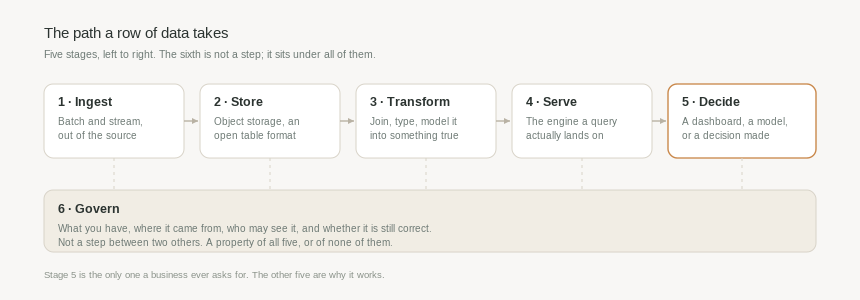
Stage 1
Ingest
Getting data out of the systems that produce it and into somewhere you can work on it — in batches, or as a stream that never stops.
Data engineers, mostly. This is the stage that wakes people up.
Latest Amazon MSK now supports in-place upgrade from Standard brokers to Express brokers AWS · 2026-11-20
Counted from Datastream, Kinesis, Amazon MSK, DataSync, Cloud Data Fusion and 17 more
Stage 2
Store
Where it lands and what it costs to keep. Object storage for the lake, operational databases for the systems still running, and increasingly an open table format over the top.
Data engineers and the platform people formerly known as DBAs.
Latest Amazon Aurora serverless for MySQL now supports up to 384 ACUs AWS · 2026-11-23
Counted from RDS, Cloud SQL for MySQL, Cloud SQL for PostgreSQL, Bigtable, S3 and 46 more
Stage 3
Transform
Turning what arrived into something a person can answer a question with: joined, de-duplicated, typed, and modelled into tables that mean something to the business.
Data engineers build the pipelines; analytics engineers own the models.
Latest AWS Glue Data Catalog introduces data quality monitoring for catalogs and databases AWS · 2026-11-20
Counted from Managed Service for Apache Airflow, Managed Service for Apache Spark, Glue, Azure Databricks, Dataform and 5 more
Stage 4
Serve
The query engine a person or a dashboard actually hits. Separating this from storage is the whole lakehouse idea: one copy of the data, several engines over it.
Data engineers and analytics engineers, with platform teams on the bill.
Latest The reservation_override_mode and disable_on_demand_billing reservation and billing controls are Google Cloud · 2026-11-23
Counted from BigQuery, OpenSearch, Redshift, Vertex AI Search, Log Analytics and 3 more
Stage 5
Decide
The part that justifies the other five. A dashboard somebody reads on a Monday, a forecast, a model in production — or a decision that gets made the same way it always was.
Data analysts and data scientists, and the people they report to.
Latest Amazon SageMaker Studio now supports training job submission and model deployment for SageMaker AWS · 2026-11-23
Counted from Looker, SageMaker, Data Studio
Stage 6
Govern
Knowing what you have, where it came from, who may see it, and whether it is still correct. The stage everyone agrees matters and nobody budgets for.
Data stewards and governance leads, where those roles exist at all.
Latest AWS Clean Rooms supports writing PySpark job results to intermediate tables AWS · 2026-11-18
Counted from Knowledge Catalog, Sensitive Data Protection, Clean Rooms
The format question, being answered in public
Iceberg, Delta Lake and Hudi solve the same problem: transactional tables over object storage, so several engines can read one copy without trampling each other. Which one wins is usually argued about. It can also just be counted — mentions across all three clouds’ own announcements in the window, rolled up so a repeated note counts once.
Vendor attention, not installed base. It says what the clouds are building against; it does not say what is running in your warehouse.
What the engines shipped
The clouds rent you a platform; these are the parts it is built out of. A tagged release is a fact with a date, which is why this reads release feeds rather than company blogs wherever a project publishes them. Release candidates and nightly build tags are excluded — counting those makes a project’s cadence a measure of how publicly it tests.
| Project | Stage | Held | Most recent |
|---|---|---|---|
| DuckDB | Store | 10 | DuckDB v2.0.1 Bugfix Release · 2026-11-20 |
| dbt Core | Transform | 10 | dbt v1.12.7 · 2026-11-12 |
| Great Expectations | Govern | 10 | 1.25.0 · 2026-11-12 |
| Trino | Serve | 10 | Trino 484 · 2026-10-16 |
| Apache Hudi | Store | 5 | 1.1.2 Release · 2026-10-20 |
| Apache Spark | Transform | 4 | v4.3.0 · 2026-10-27 |
| Delta Lake | Store | 4 | dbi-20261012-3004ec8c3 · 2026-10-12 |
| Apache Kafka | Ingest | 3 | 4.3.2 · 2026-10-20 |
| Apache Iceberg | Store | 3 | apache-iceberg-1.12.0 · 2026-09-30 |
| Apache Flink | Ingest | 3 | release-2.3.0 · 2026-06-22 |
| Apache Airflow | Transform | 1 | airflow-ctl/0.1.6 · 2026-11-22 |
| MongoDB (blog) | Store | 150 | MongoDB is a Leader in The Forrester Wave™: Translytical Data · 2026-11-19 |
| Elastic (blog) | Serve | 40 | Elastic and HoneyHive join forces to advance AI observability · 2026-11-19 |
| Databricks (blog) | Transform | 10 | Interactive Databricks Reference Architectures Across 70 Indus · 2026-11-20 |
What the independents earn
Total company revenue for the most recent quarter each firm has filed, read from its own 10-Q or 10-K at the SEC. Not a data-platform segment — none of them break one out, and inventing a split would be the error that makes a page like this worthless.
| Firm | What the revenue covers | Quarter | Revenue | Year on year |
|---|---|---|---|---|
| Snowflake SNOW | the data cloud; all of it | 2026-07-31 | $1.55B | +35% |
| MongoDB MDB | Atlas plus the self-managed server | 2026-07-31 | $0.77B | +30% |
| Elastic ESTC | search, observability and security | 2026-10-31 | $0.50B | +17% |
| Teradata TDC | the incumbent warehouse | 2026-09-30 | $0.40B | -4% |
| Databricks | private; has never filed | — | — | — |
| Confluent | deregistered 2026-03-27 (Form 15-12G); last reported quarter stands | — | $0.30B at 2025-09-30 | — |
Who does what
Editorial, and the titles vary by company. What does not vary is the work, which is why the stages come first and the titles hang off them.
- Data engineer — ingest · store · transform
Moves and shapes data, owns the pipelines and whatever wakes up at 3am. Lives in SQL, Python and Spark, and increasingly in Terraform. - Analytics engineer — transform · serve
The role that did not exist ten years ago. Owns the models between the raw tables and the dashboard — dbt, tests, documentation, semantics. Closer to software engineering than to analysis. - Data analyst — serve · decide
Answers the question that was asked and, usefully, the one that should have been. SQL and a BI tool, and more influence on decisions than the org chart suggests. - Data scientist — decide
Statistics and modelling where an answer has to be inferred rather than queried. The part of the field that AI tooling has changed most in two years. - Platform engineer / DBA — store · govern
Still here, under a different title. Capacity, recovery, cost, security and the question of whether that restore has ever actually been tested.
Data quality, as checks that can fail
“Ensure data quality” is not a plan. These six are, because each is an assertion a pipeline can run and stop on. Same discipline this site’s own publishing checks use: a check that cannot fail is worse than no check.
Freshness
The newest row is younger than the interval that is supposed to produce it.
A feed that stops looks exactly like a quiet week. This is the check that notices.
SELECT MAX(loaded_at) AS newest
FROM   orders
HAVING MAX(loaded_at) < CURRENT_TIMESTAMP - INTERVAL '2' HOUR;
Row-count delta
Today’s load is within a band of the trailing average.
Catches the half-written load and the duplicated one, which are the two common shapes of a broken job.
WITH daily AS (
  SELECT load_date, COUNT(*) AS n
  FROM   orders GROUP BY load_date
), recent AS (
  SELECT AVG(n) AS avg_n FROM daily
  WHERE  load_date >= CURRENT_DATE - 7
    AND  load_date <  CURRENT_DATE
)
SELECT d.n, r.avg_n
FROM   daily d, recent r
WHERE  d.load_date = CURRENT_DATE
  AND  d.n NOT BETWEEN 0.8 * r.avg_n
                   AND 1.2 * r.avg_n;
Null rate
A column that is never null stays never null.
An upstream rename usually arrives as a column going entirely null rather than as an error.
SELECT COUNT(*) AS missing_customer_id
FROM   orders
WHERE  load_date = CURRENT_DATE AND customer_id IS NULL
HAVING COUNT(*) > 0;
Referential
Every foreign key resolves.
The join that silently drops rows is a wrong number, not a failed job.
SELECT o.order_id
FROM   orders o
LEFT   JOIN customers c ON c.customer_id = o.customer_id
WHERE  o.load_date = CURRENT_DATE
  AND  c.customer_id IS NULL;
Schema drift
Columns and types are the ones the model expects.
A widened type or a reordered column breaks a consumer downstream, later, with no trace back to here.
SELECT column_name, data_type
FROM   information_schema.columns
WHERE  table_name = 'orders'
EXCEPT
SELECT column_name, data_type FROM orders_contract;
Distribution
The shape of the data has not moved more than it should.
The only one that catches a correct pipeline carrying wrong data, which is the failure nobody notices for a quarter.
WITH today AS (
  SELECT AVG(amount) AS a FROM orders WHERE load_date = CURRENT_DATE
), baseline AS (
  SELECT AVG(amount) AS a, STDDEV(amount) AS s FROM orders
  WHERE load_date BETWEEN CURRENT_DATE - 30 AND CURRENT_DATE - 1
)
SELECT today.a AS today_avg, baseline.a AS baseline_avg
FROM today, baseline
WHERE ABS(today.a - baseline.a) > 3 * baseline.s;
Each one returns rows only when it fails, which is the whole design: a check that returns a number needs somebody to decide whether the number is bad, and nobody ever does. ANSI SQL — they read the same on Snowflake, BigQuery, Redshift or Postgres, and the interval syntax is the one thing your engine will argue with.
Before any of this was a platform
The database writing on this site, from the years when the storage layer was a machine you could walk up to. Read out of the archive, not a list I keep by hand.
- Oracle 19c: PDB‑to‑PDB Clone & Refresh Using Database Links (SE2) · 2026-04-01
- Ansible Automation Platform Jobs Stuck in Pending: Root Cause and Fix · 2026-03-31
- Designing Reliable and Cost-Effective SQL Server Backups to Azure · 2026-03-27
- ASM Integrity check failed with PRCT-1225 and PRCT-1011 errors while creating · 2023-11-04
- Archive MongoDB data in Azure · 2023-11-01
- Lock Tables in MariaDB · 2023-11-01
- Studio 3T · 2023-11-01
Where every number here came from
| Section | Source | Refreshed |
|---|---|---|
| The six stages, the format question | The three clouds’ own announcement feeds, held in this site’s store — 4,880 rows in the window | three times a day |
| What the engines shipped | 14 release and blog feeds, 263 items held | weekly, Mondays |
| What the independents earn | SEC EDGAR company facts (XBRL) — each firm’s own 10-Q or 10-K | weekly |
| The stage mapping, the roles, the quality checks | Mine. Editorial, and checked by check_data_page.py on every push | when I change it |
Window 2025-11-24 to 2026-11-24. Cloud announcements are counted as a share of each cloud’s own output and rolled up on the normalised headline, so one note repeated counts once. What this method cannot see is written down in scripts/build_data_page.py.