Business Challenge
A team sizes a Bedrock workload from the price list, doubles it for safety, and ships. Within a week it is returning throttling errors while the bill sits at a fraction of the budget.
The instinct is to look for a billing error, then for a leak. There is neither. Quota and cost are both counted in tokens, and they are consumed at different rates — so the number you budgeted and the number that throttles you were never the same number.
AWS defines a “burndown rate” — “the rate at which input and output tokens are converted into token quota usage for the throttling system.” For output tokens it is not 1:1.
“The burndown rate for Anthropic Claude models version 4.8 is 15x for output tokens… and the burndown rate for Anthropic Claude Opus 5.5, Claude Sonnet 5, Claude Opus 5, and Claude Fable 5.1 is 10x… For all other Anthropic models version 4.7 and below, the burndown is 5x… For all other models, the burndown rate is 1:1.”
And then the sentence that separates the two currencies entirely: “You're only billed for your actual token usage.”
FixBudget cost from the price list and capacity from the burndown rate. They are not convertible.
max_tokens is spent before the model writes a word
Quota is deducted on the way in, not on the way out:
“At the start of the request – The following sum is deducted from your quotas…
Total input tokens + max_tokens. The request is throttled if you exceed
a quota.”
So max_tokens is a reservation, and an optimistic one is paid for in
concurrency. AWS's own worked example sets it to 32,000 against a response that turns out to be
1,000 tokens: “Initial deduction when request is made: 36,000…
Final adjusted deduction after response is generated: 9,000.”
That is four times the quota the completed request actually used, held for the duration and unavailable to anything else.
FixSet max_tokens to the size of the answers you actually get, not to the model's ceiling.
The answer to throttling is supposed to be Provisioned Throughput — buy capacity, stop being throttled. But the list of models you can buy it for is not the list of models you are using.
On the supported-models page, the newest Anthropic entry is Claude 3.5 Sonnet v2. The models carrying the 15x and 10x burndown rates — the ones whose quota cost is highest — do not appear on it at all.
Region coverage narrows it again: most entries are single-Region, and every Claude 3.5 Sonnet
variant is us-west-2 only.
Check the supported list before designing around Provisioned Throughput. It is not a general escape.
Architecture
The useful frame is two products, not one product with two prices.
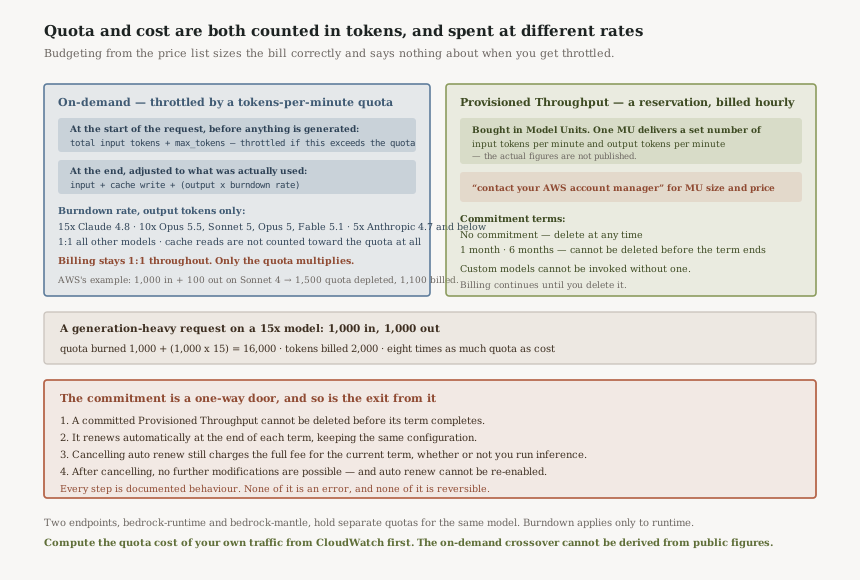
On-demand: the limit is not the one you budgeted
The arithmetic at the end of a request is precise, and every term in it matters:
InputTokenCount + CacheWriteInputTokenCount + (OutputTokenCount x burndown rate).
AWS works it through: 1,000 input tokens producing 100 output tokens on Claude Sonnet 4 means “1,500 tokens (1,000 + 100 x 5) will be depleted from your TPM and TPD quotas” while “You'll only be billed for 1,100 tokens.”
Push that to a generation-heavy workload on a 15x model — 1,000 in, 1,000 out — and the request burns 16,000 tokens of quota while billing 2,000. Eight times as much quota as cost, for the same request.
“CacheReadInputTokenCount don't contribute to this calculation and are not counted toward your quota.” Prompt caching is usually filed under cost reduction. It is also the only lever in the formula that buys back throughput, because a cache read is free against the quota as well as cheaper on the bill. On a workload with a large stable prefix, that is the difference between being throttled and not.
Provisioned Throughput: a reservation, priced privately
Capacity is bought in Model Units. An MU “delivers a specific throughput level for the specified model” — a number of input tokens per minute and a number of output tokens per minute.
What those numbers are, AWS does not publish: “For more information about what an MU specifies, pricing per MU, and to request limit increases, contact your AWS account manager.”
That is worth sitting with, because it decides how this post can honestly end. The break-even between on-demand and provisioned is a function of the throughput one MU delivers and what it costs, and neither is public. Nobody can compute that break-even from the documentation — not me, and not you. It is a conversation with an account team, and any blog post that prints a crossover point for it is printing a guess.
Why This Architecture Holds Up
The commitment is a one-way door with a default that closes it again
The three terms look like a normal discount ladder: “No commitment – You can delete the Provisioned Throughput at any time. 1 month – You can't delete the Provisioned Throughput until the one month commitment term is over. 6 months – You can't delete… until the six month commitment term is over.”
The part that is not a normal discount ladder is what happens next: “Your Provisioned Throughput will automatically renew at the end of each commitment term.” A six-month commitment is not a six-month decision unless somebody diaries it.
Cancelling auto renew does not stop the current bill: “you will still be charged the full provision fee for your current term, whether you run inference or not.” It also freezes the resource — “you can't make any further modifications to your Provisioned Throughput for the remainder of the commitment term” — and it cannot be undone: “Auto renew cannot be re-enabled after it is cancelled.” So the sequence is: commit, forget, renew, cancel, and then run six months of a resource you can neither resize nor stop paying for. Every step of that is documented and none of it is an error.
Two endpoints, two quotas, one model
A detail that will confuse exactly one incident per organisation:
“Amazon Bedrock offers two inference endpoints – bedrock-runtime
and bedrock-mantle – each with its own per-model quota allocations.
Traffic to the two endpoints is tracked against separate quotas, even when calling the same
underlying model.”
Burndown does not cross over either: it “applies only to models available on the
bedrock-runtime endpoint”, while mantle-only models
“have separate quotas for input and output tokens, so burndown does not apply.”
Two services' worth of capacity behaviour behind one model name.
Customisation removes the choice
One line collapses this entire decision for anyone fine-tuning: “If you customized a model, you must purchase Provisioned Throughput to be able to use it.”
So a custom model is not a model change, it is a billing-model change — from per-token to hourly, “Billing continues until you delete the Provisioned Throughput.” The cost of fine-tuning is not the training run; it is the floor under every hour afterwards. And in GovCloud (US-West) it is the only thing supported at all, “only for custom models with a no-commitment purchase.”
Key Architecture Decisions
| Decision | Choice | Reasoning |
|---|---|---|
| Capacity planning input | Burndown rate, not price | Output tokens burn up to 15x quota while billing stays 1:1. |
max_tokens |
Sized to real completions | Deducted in full up front. AWS's example reserves 36,000 for a 9,000 request. |
| Prompt caching | Treat as a capacity lever | Cache reads are not counted toward quota — the only term that gives throughput back. |
| Model choice | Check burndown before benchmarking | A 15x model and a 1:1 model need different quota headroom at the same spend. |
| Provisioned Throughput | Only with an account-team number | MU throughput and price are unpublished; no break-even is computable without them. |
| Commitment term | No commitment until measured | 1 and 6 month terms cannot be deleted early, and renew automatically. |
| Auto renew | Diarised before the term ends | Cancelling is irreversible, still bills the full term, and freezes modifications. |
| Fine-tuning | Budget the hourly floor, not the run | A custom model cannot be invoked without Provisioned Throughput. |
The measurement worth taking first
Before any of this is a capacity decision, it is an observability one. The burndown formula is built
from CloudWatch metrics you already have — InputTokenCount,
OutputTokenCount, CacheReadInputTokenCount,
CacheWriteInputTokenCount — so the quota cost of your real traffic
can be computed rather than estimated.
Do that before comparing it to anything. A workload whose output-to-input ratio is small is barely affected by a 15x multiplier; one that generates long answers from short prompts is dominated by it. The same spend produces completely different capacity profiles, and only the metrics know which one you have.
Closing Thought
The pricing page answers one question well: what will this cost per token. It is silent on the question that actually stops a launch, which is how much of it you are allowed to do per minute.
Those two are related by a multiplier that lives on a different page, applies to only some models, changes with model version, and runs as high as fifteen. A team that reads only the first page will budget correctly and still be throttled, and every instinct will point at the bill, which is the one thing that is behaving exactly as documented.
The honest conclusion of a cost-lens post is usually a number. This one cannot be, and that is the finding: the crossover between on-demand and provisioned depends on two figures AWS publishes to account managers and not to documentation. What you can do without them is measure the quota cost of your own traffic, which is computable today, and refuse to sign a six-month commitment against a break-even nobody can show you.
AI & ML — vector storage for retrieval: OpenSearch Serverless, pgvector on Aurora and S3 Vectors, what each one costs at rest versus at query time, and why the cheapest place to keep embeddings is not always the cheapest place to search them.
Official AWS Reference
- How tokens are counted in Amazon Bedrock — burndown rates, the deduction formula, and the max_tokens worked examples
- Increase model invocation capacity with Provisioned Throughput — model units, commitment terms, and the custom-model requirement
- Delete a Provisioned Throughput or cancel auto renew — automatic renewal and what cancelling does and does not stop
- Quotas for Amazon Bedrock — the two inference endpoints and their separate allocations
- Supported Regions and models for Provisioned Throughput — the model list and its Region coverage
Comments