Business Challenge
“ACM provides managed renewal for your Amazon-issued SSL/TLS certificates. This means that ACM will either renew your certificates automatically (if you are using DNS validation), or it will send you email notices when expiration is approaching.”
Two conditions are already in that sentence and a third follows immediately. Taken together they decide whether the thing you are relying on actually happens.
AWS publishes the list rather than describing it, which is generous, and the list repays reading as a whole rather than as four separate rules:
“ELIGIBLE if associated with another AWS service, such as Elastic Load
Balancing or CloudFront.”
“ELIGIBLE if exported since being issued or last
renewed.”
“ELIGIBLE if it is a private certificate issued by calling the ACM
RequestCertificate API and then exported or associated with another AWS
service.”
“ELIGIBLE if it is a private certificate issued through the management
console and then exported or associated with another AWS service.”
Four entries, two verbs. Associated, or exported. Both mean something took the certificate and did something with it. Issuance alone appears on neither side of the condition — in the two private cases AWS spells out that issuing it is not enough, and names the follow-on action explicitly.
So a certificate requested in advance for a service you have not stood up yet, or kept for a planned migration, is not accumulating renewal. It is sitting there with an expiry date and nothing watching it.
FixInventory the certificates in your account that are attached to nothing and have never been exported. That set is exactly the set that will not renew, and it is usually populated by good intentions — certificates requested early, for things that slipped.
“NOT ELIGIBLE if it is a private certificate issued by calling the AWS
Private CA IssueCertificate API.”
Note how narrowly that is drawn against the eligible case above it. The same private CA, issuing the
same kind of certificate, lands on opposite sides depending on which API you called. ACM's
RequestCertificate gets managed renewal; Private CA's IssueCertificate does
not. #71 covered the CA side of that split.
“NOT ELIGIBLE if imported.” Expected, and worth stating because an imported certificate looks identical in the console to an issued one.
And the one to design around: “NOT ELIGIBLE if already expired.”
Managed renewal does not rescue a lapse. Once a certificate has gone past its expiry the automation stops being the answer and a human is required, which means the failure mode compounds: the mechanism you were depending on withdraws at precisely the moment you discover you needed it.
FixAlarm on days-to-expiry independently of ACM, for every certificate you care about. The one state where ACM will definitely not help is the one where you most need telling, so the monitoring cannot be the same system as the renewal.
ACM offers a second way to get certificates, for the case the integrated services do not cover: “To automate public certificate issuance and renewal outside integrated services such as on Amazon EC2 instances, use the ACME protocol.”
That is the right tool for a web server on an instance, where nothing is going to associate a certificate on your behalf. But the two paths are explicitly exclusive:
“ACME certificates (certificates with CertificateKeyPairOrigin of ACME)
cannot be used with AWS integrated services. To use certificates with the services
listed below, use ACM-managed certificates with a key pair origin of AWS_MANAGED or
CUSTOMER_PROVIDED.”
And the renewal ownership moves with it: “Certificates issued through ACME certificate automation are not eligible for ACM managed renewal. Renewal of ACME certificates is managed by the ACME client.”
So choosing ACME is choosing a different renewal owner as well as a different issuance path. It is coherent — an ACME client renews, which is what ACME is for — and it means a single sentence in a runbook saying that ACM renews your certificates is false for some of them.
There is a third option named for the case where ACME does not fit: “Alternatively, if you cannot use ACME, you can automate exportable certificates issued from ACM through AWS Workload Credentials Provider.”
FixRecord the CertificateKeyPairOrigin alongside each certificate in your inventory. It determines both where the certificate can be used and who renews it, and it is not visible in a conversation that treats every ACM certificate as one kind of thing.
Architecture
One eligibility test, three ways to fail it, and two issuance paths with different renewal owners.
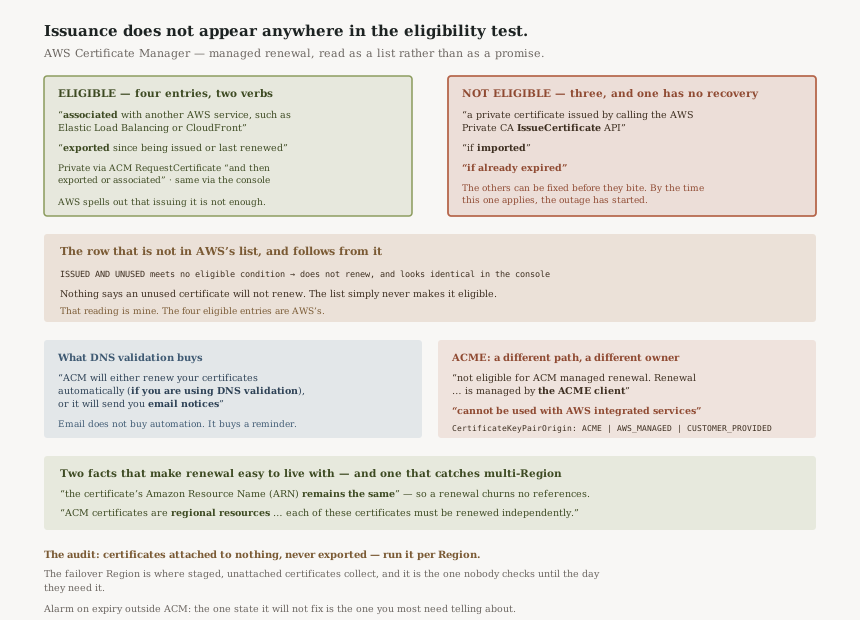
The eligibility list, rearranged
| Situation | Renews automatically? | What actually decides it |
|---|---|---|
| Attached to ELB, CloudFront or another integrated service | Yes | “associated with another AWS service” |
| Exported since issue or last renewal | Yes | “exported since being issued or last renewed” |
| Issued and sitting unused | No | It meets no eligible condition |
Private, via ACM RequestCertificate, then used |
Yes | The use, not the issuance |
Private, via Private CA IssueCertificate |
No | Explicitly listed as not eligible |
| Imported | No | Explicitly listed as not eligible |
| Already expired | No | Explicitly listed as not eligible |
| Issued through ACME | Not by ACM | “managed by the ACME client” |
The third row is the one that is not in AWS's list and follows from it. Nothing states that an unused certificate will not renew; the list simply never makes it eligible. That is my reading of the list rather than a statement AWS makes, and it is the reading the four eligible entries support.
The condition sits in the opening sentence and is easy to read past: ACM renews automatically “(if you are using DNS validation)”, or else “it will send you email notices when expiration is approaching”.
So email validation does not buy you automation. It buys you a reminder, and a reminder is only as good as the mailbox it lands in — which for a certificate issued three years ago by somebody who has since changed teams is a specific and familiar kind of problem.
Two facts that make renewal easier to live with
“When ACM renews a certificate, the certificate's Amazon Resource Name (ARN) remains the same.”
That is a real kindness. A renewal does not churn references, does not require a Terraform apply, and does not show up as a change in anything holding the ARN. It is the reason renewal can be invisible when it works.
And the one that catches multi-Region designs: “ACM certificates are regional resources. If you have certificates for the same domain name in multiple AWS Regions, each of these certificates must be renewed independently.”
Which means eligibility is evaluated per Region too. A certificate attached to a load balancer in one Region tells you nothing about its twin in another, and the twin is exactly the kind of certificate that ends up attached to nothing — created for a failover that has not happened yet.
One more, for anyone with internationalised domains
Two Punycode requirements are listed among the renewal conditions. A domain name beginning with any two
characters followed by -- must match xn--; and a domain name beginning with
xn-- must also be a valid Internationalized Domain Name. AWS gives a worked table of allowed
and disallowed examples alongside them.
Worth knowing this exists if your estate includes anything matching that shape, because it is a condition on renewal rather than a one-time check at issue.
Why This Architecture Holds Up
Tying renewal to use is the right default, and the right place to be surprised
The alternative is renewing everything forever. For a service that issues certificates free and at scale, that is an unbounded commitment to reissue material nobody has looked at in years, and it is exactly the kind of silent accumulation that creates key sprawl.
Making use the trigger means the system maintains what is load-bearing and lets the rest lapse. The honest cost is that letting the rest lapse includes the certificate you deliberately staged for next quarter's migration.
Separating ACME from the integrated services is coherent, not arbitrary
An integrated service associates the certificate itself, which is what makes ACM's renewal observable and automatic. On the ACME path AWS places renewal with the client instead — “Renewal of ACME certificates is managed by the ACME client” — and withholds the integrated services. Two different owners of the same job, and a certificate carries one origin value, not both.
Every other ineligible state can be fixed before it bites: attach the certificate, export it, reissue through the other API. “NOT ELIGIBLE if already expired” cannot, because by the time it applies the outage has started.
This is the argument for expiry monitoring that does not live inside ACM. A system that stops helping in exactly one state should not also be the system that tells you that you are in it.
Publishing the list beats describing the behaviour
AWS could have written a paragraph about how managed renewal generally works. Instead there are eight labelled lines, four ELIGIBLE and three NOT ELIGIBLE plus the ACME note, each short enough to check a certificate against. That is the difference between documentation you read and documentation you can audit against.
Key Architecture Decisions
| Decision | Choice | Reasoning |
|---|---|---|
| Validation method | DNS, wherever you control the zone | Automatic renewal is conditioned on it; email gets notices instead. |
| Expiry monitoring | Outside ACM, on every certificate | “NOT ELIGIBLE if already expired” — the one state it will not fix. |
| Staged certificates | Treat as unmanaged until attached | Every eligible condition requires association or export. |
| Private certificates | Prefer ACM RequestCertificate |
Private CA IssueCertificate is explicitly not eligible. |
| Certificates on EC2 | ACME, and own the renewal | Renewal is “managed by the ACME client”, not by ACM. |
| Mixing paths | Do not | ACME certificates “cannot be used with AWS integrated services”. |
| Inventory field | Record CertificateKeyPairOrigin |
It decides usability and renewal ownership together. |
| Multi-Region | Audit per Region, not per domain | Each “must be renewed independently”. |
| Imported certificates | Own the whole lifecycle | Managed renewal never applies to them. |
The audit worth running
List every ACM certificate with no associated resource and no export since issue. That is the not-renewing set, expressed as a query rather than as a worry. In most accounts it is small, and in most accounts at least one entry is load-bearing for something that has not launched yet.
Then run it per Region. The failover Region is where staged, unattached certificates collect, and it is the Region nobody checks until the day they need it.
Closing Thought
The useful question about ACM is not does it renew my certificates but what does this particular certificate do for a living. Attached to a load balancer, it renews. Exported to a server, it renews. Issued last March for a project that slipped, it does not, and nothing about it looks any different in the console.
That is a defensible design — maintaining material nobody uses is how you end up with a cryptographic estate you cannot account for. It is just not the design most people describe when they say a certificate is managed.
#94 was a service whose surprises were about which account owns the instance. This one is about which relationship owns the renewal. Both reward the same move: reading the prerequisites and the eligibility lists rather than the first sentence, because the first sentence is the summary and the conditions are where the service actually lives.
Security & Identity — AWS Config: why a recorder is a per-Region decision with an account-wide bill, what a conformance pack actually deploys, and the difference between a rule that is non-compliant and one that never evaluated.
Official AWS Reference
- Managed certificate renewal in AWS Certificate Manager — the DNS-validation condition on automatic renewal and the email-notice alternative, the full eligibility list with its four eligible and three ineligible cases, the ACME exclusion and the ACME client's ownership of renewal, the unchanged ARN, the per-Region independence, and the Punycode requirements
- Managed automation with integrated services — the integrated service list, the ACME protocol for issuance outside those services, the CertificateKeyPairOrigin exclusion and the AWS_MANAGED and CUSTOMER_PROVIDED alternatives, and AWS Workload Credentials Provider
- What is AWS Certificate Manager? — further reading on the service overview; no claims in this post are drawn from it
Comments