Business Challenge
CloudWatch Logs offers two classes of log group. The Standard class is “a full-featured option for logs that require real-time monitoring or logs that you access frequently”. The other is now called Essentials: “CloudWatch Logs Essentials log class (formerly Infrequent Access) is a log class that you can use to cost-effectively consolidate your logs”, offering “a subset of CloudWatch Logs capabilities including managed ingestion, storage, cross-account log analytics, and encryption with a lower ingestion price per GB”.
Read quickly, that is a storage-tier decision of the kind S3 trained everyone to make: colder data, cheaper shelf, slower retrieval. Read carefully, it is not that at all. The shelf costs the same, the retrieval costs the same, and what you give up is the equipment.
The documentation is unusually direct about this, in a note rather than in the marketing:
“For charges, the Standard and Essentials (formerly Infrequent Access) log classes differ in ingestion costs only. Storage charges and CloudWatch Logs Insights charges are the same in each log class.”
So the mental model imported from S3 storage classes is wrong in both directions. There is no storage discount to collect by moving cold logs, and there is no retrieval penalty to fear. The entire economic difference happens once, when the log event arrives, and never again.
That reframes which log groups are candidates. The question is not how often will we read this — reading costs the same either way. It is how much of this arrives, weighed against the features in the next two challenges. A high-volume log group nobody alarms on is the ideal case. A low-volume log group that somebody reads constantly saves almost nothing in Essentials and gives up a great deal.
FixRank candidate log groups by ingested volume, not by access frequency, and set the saving against the feature list rather than against a retrieval fee that does not exist. #48 covered the per-gigabyte arithmetic of CloudWatch logging and is the place to take the rates from; this post is about what the cheaper rate costs you in capability.
Two rows of the support table interact badly, and neither is obvious in isolation.
The first removes the cheap read path: “GetLogEvents” and “FilterLogEvents” are “Not supported. Use CloudWatch Logs Insights to view log events stored in log groups in the Essentials (formerly Infrequent Access) log class.” Those two APIs are what the console's log-stream view, most CLI one-liners and nearly every home-grown log viewer use. In Essentials they do not exist, so every act of looking at a log line goes through Logs Insights — which, per #112 and #113, is billed under the “DataScanned-Bytes” usage type against “StartQuery”.
The second removes the discount on that: field indexing is listed as supported in Standard and not supported in Essentials, and the query language follows — “Log groups in the Essentials log class (formerly Infrequent Access) support all query commands except pattern, diff, filterIndex, and unmask.”
Put the two together. In the cheaper class, every read is a scan you pay for, and #113's entire subject — the policy that reduces scan volume, and the command that restricts a query to indexed data — is unavailable. You chose the class to save money on logs you rarely read, and in exchange the reads you do perform are the expensive kind with no optimiser.
FixMake the volume saving large enough to cover unoptimised queries, and keep the log groups you actually investigate in Standard where an index can serve them. Where a log group must be in Essentials, control read cost with the levers that still work: narrow time ranges, fewer log groups per query, and a custom scheduled-query shape rather than ad-hoc exploration.
#112 described two documented ways to alarm on log data: a metric filter feeding a metric alarm, or a Log Alarm evaluating a scheduled Logs Insights query. In Essentials, metric filters are listed as supported in Standard and not supported in Essentials — so the first route is closed. Subscription filters are likewise unsupported, which also removes the escape hatch of streaming events out to Lambda, Firehose or a third party and doing the detection yourself.
What survives is the second route: Scheduled Queries are supported in both classes, so a Log Alarm still works. Which lands you back in challenge 2, because a Log Alarm's cost is the data its query scans, and the index that would have reduced it does not exist here.
Several other real-time features go with them: Live Tail, CloudWatch Logs Anomaly Detection, Embedded metrics format, Container Insights log ingestion, Lambda Insights log ingestion, Facets, Natural language query assist and Compare to previous time range are all Standard-only. The pattern across the whole list is consistent: Essentials keeps ingestion, storage, encryption, cross-account access, export and querying, and drops everything that watches a log as it arrives.
And the decision is not revisitable: “After a log group is created, its log class can't be changed.” There is no transition, no lifecycle rule, no API call. Moving a workload between classes means a new log group, which means every producer's configuration, every IaC reference, every dashboard query and every alarm that names the old group.
FixDecide the class in the same change that creates the log group, and record the reason beside it — the next person cannot infer it and cannot undo it. For anything you are unsure about, create it in Standard: it is the class with every feature, and the only cost of being wrong is ingestion price on data you could have consolidated more cheaply. Being wrong the other way costs a migration.
Architecture
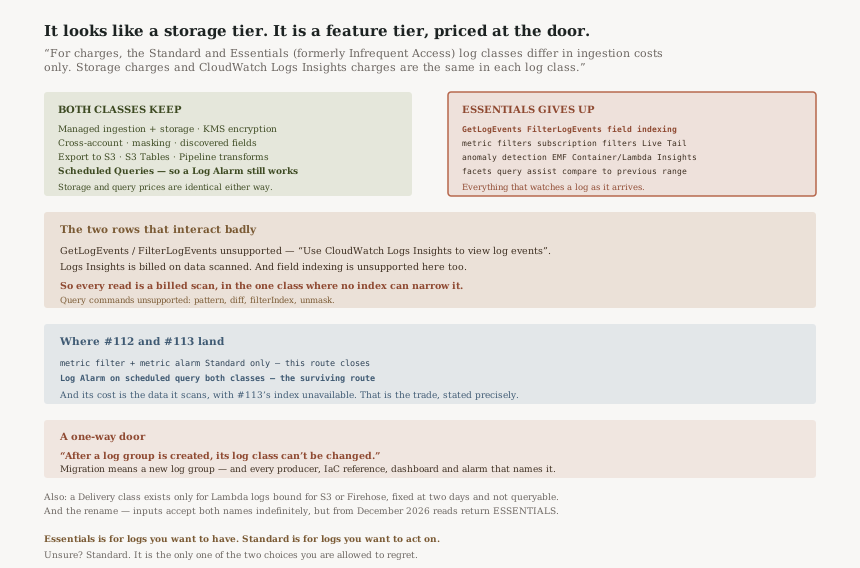
What each class keeps and loses
| Capability | Standard | Essentials |
|---|---|---|
| Managed ingestion and storage | Yes | Yes |
| Cross-account features, KMS encryption, masking | Yes | Yes |
| Logs Insights queries and discovered fields | Yes | Yes, most commands |
| Scheduled Queries | Yes | Yes |
| Export to S3, S3 Tables integration, Pipeline transforms | Yes | Yes |
GetLogEvents / FilterLogEvents | Yes | Not supported |
| Field indexing | Yes | No |
| Metric filters | Yes | No |
| Subscription filters | Yes | No |
| Live Tail, Anomaly Detection, Facets, query assist, time comparison | Yes | No |
| Embedded metrics format | Yes | No |
| Container Insights and Lambda Insights log ingestion | Yes | No |
Read the No column as a single statement rather than a list of gaps. Everything removed is something that watches a log as it arrives or turns it into something else: a tail, a metric, a stream, an anomaly model, an embedded metric. Everything kept is ingestion, retention, protection and after-the-fact querying. Essentials is a consolidation tier for logs you want to have, not logs you want to act on, which is exactly what “ideal for ad-hoc querying and after-the-fact forensic analysis on infrequently accessed logs” says.
Where the previous three posts land in each class
| From | Mechanism | Standard | Essentials |
|---|---|---|---|
| #112 | Metric filter plus metric alarm | Available | Unavailable — metric filters unsupported |
| #112 | Log Alarm on a scheduled query | Available | Available — Scheduled Queries are supported |
| #113 | Field index policy | Available | Unavailable |
| #113 | filterIndex command |
Available | Unavailable — one of four unsupported commands |
The surviving combination is the one whose cost is proportional to data scanned, in the class where the scan cannot be narrowed by an index. That is not a flaw to report; it is the trade, stated precisely. It is also the single most useful thing to know before putting a log group that alarms on anything into Essentials.
The four query commands that stop working
“All Logs Insights QL query commands are supported on log groups in the Standard log class”, while Essentials supports “all query commands except pattern, diff, filterIndex, and unmask”.
Each absence tells you something. filterIndex follows from field indexing being
unsupported. unmask is consistent with masking being supported but the privileged
reveal not being — the data protection applies, and the escape from it does not.
pattern and diff are the two commands that do automated analysis across a
result set, which is the same category as the anomaly detection and time-comparison features that are
also absent.
The third class, which is not a tier at all
“In addition to these two log classes, there is a Delivery log class. Use the Delivery log class only for delivering AWS Lambda logs to store in Amazon S3 or Amazon Data Firehose.” With a retention rule unlike anything else in the service: “Log events in log groups in the Delivery class are kept in CloudWatch Logs for two days. This retention period is fixed and cannot be changed.” And “This log class doesn't offer rich CloudWatch Logs capabilities such as CloudWatch Logs Insights queries.”
It is a transit buffer with a name that looks like a tier. Worth recognising if you see it in a
DescribeLogGroups response and wonder why the log group has no retention setting and
cannot be queried.
The rename, and what it means for your code
“The Infrequent Access log class has been renamed to Essentials. You can now create log groups with either INFREQUENT_ACCESS or ESSENTIALS as the log class value. Both values are accepted as input and will continue to be supported indefinitely.”
The part with a date on it is the read path: “Starting December 2026, API responses from DescribeLogGroups, ListLogGroups, and other read-path APIs will return ESSENTIALS instead of INFREQUENT_ACCESS for the logGroupClass field. This is a name change only. There are no changes to functionality or pricing.”
So writes are safe indefinitely and reads change next month. Anything that compares
logGroupClass to the string INFREQUENT_ACCESS — a compliance check, a
cost-attribution script, a drift detector, a Config rule's custom logic — stops matching while
continuing to run. That is the failure this series keeps finding: not an error, a quiet change in
what a comparison returns.
Why This Architecture Holds Up
Charging the difference at ingestion is the honest place to charge it
Ingestion is where CloudWatch Logs does the work that distinguishes the classes: parsing, indexing for the features Standard offers, preparing data for real-time consumption. A class that skips most of that should be cheaper exactly there, and identical afterwards. Had AWS discounted storage instead, the saving would have been disconnected from the cost actually avoided.
An immutable class is less surprising than a mutable one
A changeable class would raise questions with no good answers: what happens to the metric filters on a log group demoted to Essentials, to the indexes, to the subscription filters other teams attached? Silently breaking those on a class change would be far worse than refusing the change. The documentation's one line — “After a log group is created, its log class can't be changed” — is a guarantee as much as a restriction.
Keeping export and cross-account access in both classes is the right call
The cheaper class still supports export to Amazon S3, S3 Tables integration, cross-account features and KMS encryption. A consolidation tier that could not be exported or read across accounts would be a dead end; these are what make it a place to put logs rather than a place to lose them.
Key Architecture Decisions
| Decision | Choose this | Because |
|---|---|---|
| Choosing a class | At log group creation, with the reason recorded | “After a log group is created, its log class can't be changed” |
| When you are unsure | Standard | Being wrong costs ingestion price; being wrong the other way costs a migration |
| Ranking candidates for Essentials | By ingested volume | The classes “differ in ingestion costs only” — access frequency changes nothing |
| A log group anything alarms on | Standard | Metric filters are unsupported in Essentials, leaving only the scan-billed route |
| A log group you investigate often | Standard | Field indexing and filterIndex are unavailable in Essentials, and every read is a Logs Insights scan |
| High-volume logs nobody watches live | Essentials | Exactly the documented use case: “ad-hoc querying and after-the-fact forensic analysis” |
| Logs feeding a third-party SIEM by subscription | Standard | Subscription filters are unsupported in Essentials; export to S3 is the alternative shape |
Code reading logGroupClass |
Accept both values now | Read-path APIs return ESSENTIALS from December 2026 |
The audit worth running
List every log group in the Essentials or Infrequent Access class and check what is attached to it. A metric filter, subscription filter or index policy that was written for a Standard log group and applied to this one is configuration that cannot work. Nothing will have told you.
Grep your estate for the literal string INFREQUENT_ACCESS. Comparisons
on the read path break in December 2026; inputs are safe. This is a ten-minute search with a dated
deadline.
Check whether anything reads logs through GetLogEvents or
FilterLogEvents against an Essentials log group. Those calls are not supported
there, so a log viewer, runbook or support tool built on them has a class of log group it silently
cannot show.
Reconcile your class choices against ingested volume. Any Essentials log group with low ingestion is paying the feature price for a saving that rounds to nothing, and the only way to correct it is a new log group.
Closing Thought
Four posts in a row have turned on the same kind of discovery: a feature whose documented behaviour is narrower than its name suggests. An alarm state that means I cannot tell. A canary whose silence has two causes. A query that ran before the logs arrived. An index that only covers what arrived after it was created.
Log classes are the quietest of the four, because nothing here is hidden at all — the support table is explicit, the immutability is in bold, and the cost note is one sentence long. The hazard is entirely one of imported intuition. Everyone has made a storage-class decision before, where the trade is price against retrieval speed and the choice can be revised by a lifecycle rule. This looks like that and is not: the saving is only at the door, the reading costs the same, the equipment for reading cheaply is removed, and the door locks behind you.
Which makes the rule simple, and worth writing into whatever creates your log groups. Choose Essentials when you want the logs to exist and expect to query them rarely, with nothing watching them live. Choose Standard whenever something alarms, tails, indexes, streams or subscribes — and whenever you do not yet know, because that is the choice you are allowed to regret.
Operational Excellence — CloudWatch Logs subscription filters: how many a log group can carry, what happens to log events when the destination throttles or fails, and why a subscription filter is a different reliability contract from an export.
Official AWS Reference
- Log classes — the definitions of the Standard and Essentials classes, that the classes differ in ingestion costs only while storage and Logs Insights charges are the same, that a log group's class cannot be changed after creation, the full supported-features table including the unsupported
GetLogEventsandFilterLogEventsoperations and the Standard-only field indexing, metric filters, subscription filters, Live Tail, Anomaly Detection, embedded metrics format and Insights log ingestion, the Infrequent Access to Essentials rename with the December 2026 read-path change, and the Delivery class with its fixed two-day retention - Logs Insights QL commands supported in log classes — that all commands are supported in the Standard class, and that the Essentials class supports all commands except
pattern,diff,filterIndexandunmask - Analyzing, optimizing, and reducing CloudWatch costs — the
DataScanned-Bytesusage type againstStartQuery, which is what every read in the Essentials class goes through - Create field indexes to improve query performance and reduce scan volume — further reading on the feature that is unavailable in the Essentials class, covered in full in #113; no claims in this post are drawn from it
- Real-time processing of log data with subscriptions — further reading on the subscription filters the Essentials class does not support; no claims in this post are drawn from it
- LogGroup API reference — further reading on the
logGroupClassfield whose returned value changes in December 2026; no claims in this post are drawn from it
Comments