Three model families join SageMaker AI's serverless customization, with SFT, DPO and RFT available on each and a choice of LoRA or full fine-tuning. The page to read before you pick a combination is the sequence-length table, because the ceiling is a property of the combination rather than of the model.
“For each open weight model, each populated cell shows the maximum sequence length that you can set for that customization technique and training type by using the overridable sequence-length parameters.”
Executive summary
The announcement is a straightforward addition: “Amazon SageMaker AI now supports serverless model customization for Muse Glimmer, Qwen3.8 27B, and Ministral 3 3B, 8B, and 14B models.” Each supports “supervised fine-tuning (SFT), direct preference optimization (DPO), and reinforcement fine-tuning (RFT) techniques”, with “either low-rank adaptation (LoRA) or full fine-tuning techniques”.
Techniques times training types reads like a grid, and the documentation publishes it as one: a cell per model, per technique, per training type — with four technique columns rather than three, because RFT appears there as its two reward-signal forms, RLVR and RLAIF. What the grid shows is that the cells do not agree with each other, and that no rule of thumb carried across them survives the table.
What changed
The models are new to serverless customization; the techniques are not. The announcement places them beside an existing set: “This launch adds these models to a wide variety of models available for serverless customization on SageMaker AI, including models from the Nova, Gemma 4, Nemotron 3.5, Qwen, Llama, gpt-oss, and DeepSeek families.”
And the operating model is the part worth naming: “With serverless customization, SageMaker AI handles all infrastructure provisioning and training orchestration, so you can focus on your data and evaluation rather than cluster management, and only pay for what you use.”
Availability is four Regions: “US East (N. Virginia), US West (Oregon), Asia Pacific (Tokyo), and Europe (Ireland)”.
Architecture
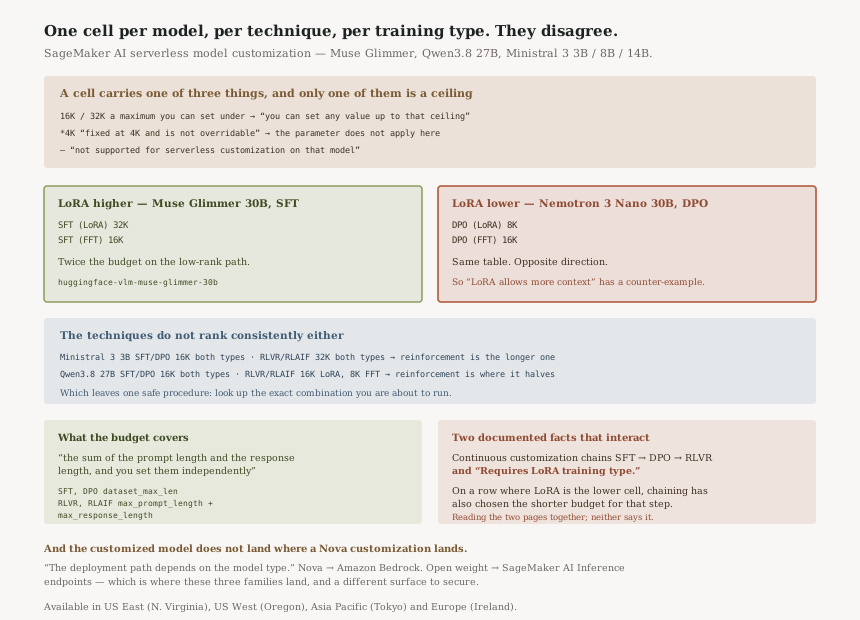
The sequence-length table has two notations under it, and the first is the one that changes what the feature means for a given model: “* means the sequence length is fixed at 4K and is not overridable. An em dash (—) means that the technique and training type are not supported for serverless customization on that model.”
So a cell carries one of three things: a ceiling you can set under, a fixed 4K you cannot change, or nothing at all. The newly announced models carry overridable values everywhere. Several of the models the announcement lists alongside them — Llama 3.3 Instruct 70B and GPT OSS 20B among others — carry the fixed 4K asterisk on all four of their SFT and DPO cells, against 16K on the same cells for the models announced today. That is four times the budget on the same two techniques, decided by which model you chose.
What the parameter actually budgets
“The sequence length is the sum of the prompt length and the response length, and you set them independently.” Which parameter you set depends on the technique:
| Technique | What you set |
|---|---|
| SFT and DPO | “Set dataset_max_len (the full prompt and completion length) up to the maximum in the following table.” |
| RLVR and RLAIF (GRPO) | “Set max_prompt_length (input budget) and max_response_length (generation budget). Their sum must stay within the model's maximum…” |
So on the reinforcement techniques the budget is split by you, between the two things competing for it. AWS
flags the trade directly:
“Response length can affect quality for tasks that require extended generation, such as coding or
mathematical reasoning. Allocate enough max_response_length for the expected output while
reserving sufficient max_prompt_length for the input.”
The direction reverses inside the same table
This is the part that defeats a rule of thumb. Four rows, all from the same published table:
| Model | Cell | LoRA | Full fine-tuning |
|---|---|---|---|
| Muse Glimmer 30B | SFT | 32K | 16K |
| Nemotron 3 Nano 30B (A3B) | DPO | 8K | 16K |
| Qwen3.8 27B | RLVR | 16K | 8K |
| Ministral 3 3B | RLVR | 32K | 32K |
Muse Glimmer's SFT row gives LoRA twice what full fine-tuning gets. Nemotron 3 Nano's DPO row gives full fine-tuning twice what LoRA gets. Both are published in the same table, so "LoRA allows more context" is contradicted by the document that would be your source for it.
And the techniques do not rank consistently either. Ministral 3 3B is listed at 16K for SFT and DPO on both training types and 32K for RLVR and RLAIF on both — the reinforcement techniques carry the longer budget there, while on Qwen3.8 27B the reinforcement techniques are where the budget halves under full fine-tuning.
Business value
AWS states the case for customising at all: “Model customization lets you tailor foundation models with your proprietary data so a smaller, right-sized model can match frontier-model quality on your tasks, while also reducing cost and latency.” And maps the three techniques to three kinds of data: labelled data for SFT, preference data for DPO, reward signals for RFT.
The serverless part is the operational value: “SageMaker AI handles all infrastructure provisioning and training orchestration… and only pay for what you use.” A customization run stops being a cluster you stand up.
Security considerations
Nothing in this launch changes an access-control boundary, but the deployment target is worth knowing before you plan one, because it is not uniform: “The deployment path depends on the model type.” Specifically, “Customized Amazon Nova models deploy to Amazon Bedrock” while “Customized open weight models deploy to SageMaker AI Inference endpoints”.
The three families announced here appear in the open weight sequence-length table, so they land on the endpoint path. That is a different surface to secure from Bedrock, and worth confirming before a design assumes one of the two.
Cost considerations
AWS declines to turn sequence length into a cost multiplier, and the hedge is the honest one: “Longer sequences can increase memory and compute requirements per example. Actual training time and cost depend on factors such as batching, packing, hardware utilization, and the training configuration.”
So doubling dataset_max_len does not predictably double the bill. It raises the per-example
cost and leaves the aggregate to things the table does not model. Measure a short run before sizing a long
one.
Operational considerations
Two documented facts interact, and the interaction is the thing to catch before you design a pipeline.
First: “Continuous customization — Chain multiple techniques sequentially (for example, SFT → DPO → RLVR). Requires LoRA training type.”
Second: on some models the LoRA cell is the lower of the two. Reading those two pages together, choosing to chain techniques also chooses LoRA, and on a model whose LoRA ceiling for one step is below its full fine-tuning ceiling, the chain has picked the shorter budget for that step. Nemotron 3 Nano's DPO row is exactly that shape. That reading is mine rather than AWS's — the two statements are documented separately and the consequence of combining them is not spelled out on either page.
Also worth noting on the ceilings themselves: “The maximums in the following table are current ceilings. You can set any value up to that ceiling.” Current, so a value that fails today may be available later — and a pipeline that hardcodes a ceiling as a constant is encoding a number AWS has told you will move.
Tradeoffs
| Choice | What you gain | What it costs |
|---|---|---|
| LoRA | Required for chaining techniques; usually the cheaper run | On some rows it is the lower sequence-length ceiling, not the higher one |
| Full fine-tuning | On some rows a higher ceiling than LoRA | Cannot be used for continuous customization |
| A longer sequence length | Room for the prompts and generations the task actually needs | “can increase memory and compute requirements per example” |
| An older listed model | Already in your stack | Its SFT and DPO cells may be “fixed at 4K and… not overridable” |
Implementation guidance
- Read the cell, not the row or the column. Look up your exact model, technique and training type in the table before you plan a sequence budget. The direction of the LoRA-versus-full-fine-tuning difference is not consistent, so there is nothing to generalise from a neighbouring row.
- Check for the asterisk and the em dash first. A fixed 4K on your technique means the overridable parameters do not apply to that cell at all; an em dash means the combination is not supported.
-
Split the reinforcement budget deliberately.
max_prompt_lengthandmax_response_lengthshare one ceiling, so under-reserving either is a quality decision rather than a configuration detail. - Decide chaining before you decide training type, since continuous customization requires LoRA and that choice may carry a lower ceiling on one of your steps.
- Plan the deployment surface. These are open weight models, so the customized artefact lands on a SageMaker AI Inference endpoint rather than in Bedrock.
Best practices
- Treat the ceiling as a value to look up per job, not a constant to store in a template.
- Size a short run first; AWS explicitly declines to predict cost from sequence length alone.
- Record the model ID, not just the model name — the table keys on IDs such as
huggingface-vlm-muse-glimmer-30b, and families carry several sizes with different cells. - Re-read the table when you revisit a job, because the maximums are described as current ceilings.
Who should adopt this and when
Now, if you are already customising on SageMaker AI and one of these three families fits the task — all eight cells on each of the newly announced models carry an overridable value, which is not true of every model in the table.
Now, if a 4K ceiling has been your blocker. If your current model's SFT and DPO cells carry the fixed asterisk, these five rows are overridable on the same cells. They are not the only ones in the table that are — Gemma 4 31B carries 32K across all four SFT and DPO cells — so this is a wider choice rather than a new capability.
Not yet, outside the four Regions named, and not without reading the deployment page if you were assuming a Bedrock endpoint at the end of the job.
Key takeaways
- Three families join serverless customization, with SFT, DPO and RFT on each and a choice of LoRA or full fine-tuning.
- The sequence-length ceiling belongs to the model-technique-training-type combination. The direction of the difference reverses between rows of the same table.
- An asterisk means fixed at 4K and not overridable; an em dash means the combination is unsupported. Check both before planning a budget.
- Continuous customization requires LoRA, which on some models is the lower ceiling of the two.
- Open weight customizations deploy to SageMaker AI Inference endpoints; Nova customizations deploy to Bedrock.
Official AWS references
- Amazon SageMaker AI now supports serverless model customization for Muse Glimmer, Qwen 3.8 and Ministral 3 models — the model list, the techniques and training types, the four Regions, and the serverless operating model (4 claims)
- Supported sequence lengths for open weight model serverless customization — the per-cell table, the asterisk and em-dash notations, what the parameter budgets for each technique, the four model rows quoted here, and the current-ceilings and cost hedges (11 claims)
- Customization techniques — the RFT reward-signal options, and continuous customization's LoRA requirement (2 claims)
- Deploying a customized model — the deployment path by model type (1 claim)
- Model customization in Amazon SageMaker AI — further reading on the overall flow; no claims in this post are drawn from it
Comments