Business Challenge
Both halves of this post are Layer 4 Network Load Balancers. They sit next to each other in the console and in #103's decision tree. They are not variants of one design.
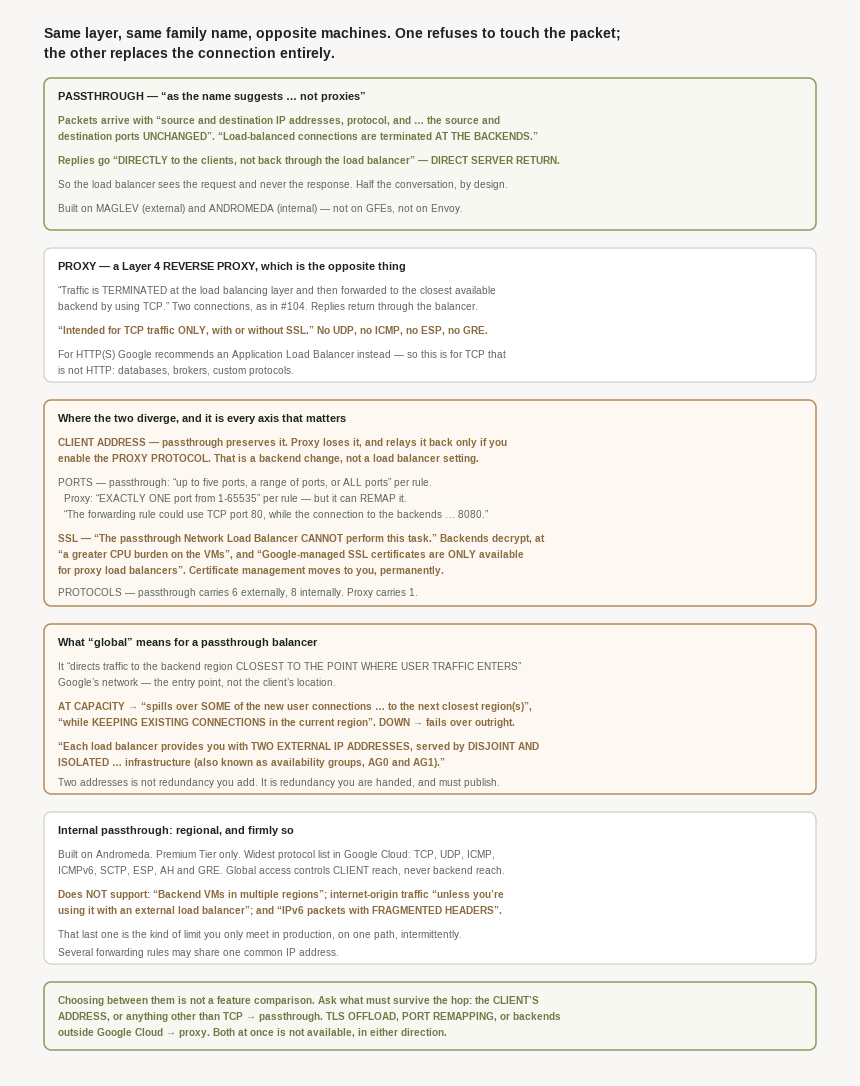
Passthrough Network Load Balancers are Layer 4 passthrough load balancers, and the documentation is emphatic about what that excludes: as the name suggests, passthrough Network Load Balancers are not proxies. The other is defined by exactly the thing the first one refuses to be — proxy Network Load Balancers are layer 4 reverse proxy load balancers that distribute TCP traffic.
Those are the two halves of the split, and you cannot have both from one load balancer. Offload requires terminating the connection; preserving the client address requires not terminating it.
The documentation does not frame it as a missing feature: it is acceptable to have SSL traffic decrypted by your backends instead of by the load balancer. The passthrough Network Load Balancer cannot perform this task. And the knock-on is lasting — Google-managed SSL certificates are only available for proxy load balancers, so certificate renewal becomes your job for as long as the design stands.
Correct approachPick the property that actually matters to the application, then recover the other as best the architecture allows. If you need the client address behind a proxy, the bridge is explicit: you can use the PROXY protocol to relay the client's source IP address and port information to the load balancer backends. That is a backend change — your application has to parse the PROXY header — not a load balancer toggle. If instead you need offload behind passthrough, there is no bridge; the backends decrypt, at a greater CPU burden on the VMs.
Correct, and unavoidable on passthrough. Responses from the backend VMs go directly to the clients, not back through the load balancer. The industry term for this is direct server return (DSR).
Correct approachMove response-side observability to the backends, because the load balancer is structurally incapable of providing it. This is the same shape as #103's note on observability, but it bites harder here: with an Application Load Balancer the proxy sees both directions and can report latency and status codes; with passthrough, anything you want to know about the response has to be measured where the response is generated.
That is a proxy capability only. Port remapping. The port used by the load balancer's forwarding rule does not have to match the port used when making connections to its backends — with the documentation's own example being the forwarding rule could use TCP port 80, while the connection to the backends could use TCP port 8080.
Correct approachOn passthrough, make the backend listen on the port the client dialled, because the packet arrives with the source and destination ports unchanged — there is nothing in the path to rewrite them. The compensation is breadth rather than flexibility: a passthrough forwarding rule takes a list of up to five ports, a range of ports, or all ports, where a proxy rule can reference exactly one port from 1-65535.
Architecture
One difference at the packet, and then divergence on every axis that follows.
What passthrough does, and what it is built on
The mechanism is simple enough to state in one sentence and it explains the whole product. Load-balanced packets are received by backend VMs with the packet's source and destination IP addresses, protocol, and, if the protocol is port-based, the source and destination ports unchanged, and load-balanced connections are terminated at the backends.
So the load balancer is a forwarding decision, not an intermediary. It picks a backend and the packet continues on its way intact — which is why the reason to choose it is stated as a requirement rather than a preference: you need to forward original client packets to the backends un-proxied.
The implementation is worth knowing because it differs from everything in #104 and #105. Neither Google Front Ends nor Envoy appear here. The global external mode is built on Maglevs that are distributed globally, operating together by using Google's global network and control plane; the regional external mode is built on Maglev and the Andromeda network virtualization stack; and an internal passthrough Network Load Balancer is a regional load balancer that is built on the Andromeda network virtualization stack.
That matters practically in one way: there is no proxy-only subnet. #103's shared prerequisite, which #105 showed becoming the data path, simply does not exist for passthrough. The packet-forwarding happens in the network fabric rather than in proxies drawing addresses from your subnet.
The two side by side
| Passthrough | Proxy | |
|---|---|---|
| Connection | Terminated at the backends | Terminated at the load balancing layer |
| Client source IP | Preserved | Lost; relayed only via the PROXY protocol |
| Response path | Direct server return — straight to the client | Back through the load balancer |
| Protocols | TCP, UDP, ESP, GRE, ICMP, ICMPv6 — plus SCTP and AH internally | TCP only |
| Ports per forwarding rule | Up to five, a range, or all | Exactly one from 1-65535 |
| Port remapping | Not possible | Supported |
| TLS offload | Cannot perform this task | Global external and classic modes |
| Google-managed certificates | Unavailable | Available |
| Built on | Maglev and Andromeda | GFEs or Envoy |
One row deserves expanding, because it is the proxy family's real niche. Proxy Network Load Balancers are intended for TCP traffic only, with or without SSL. For HTTP(S) traffic, we recommend that you use an Application Load Balancer instead. So the proxy Network Load Balancer is for TCP that is not HTTP — databases, message brokers, custom binary protocols. If your traffic is HTTP you have already left this product behind, and if it is not TCP at all you never reached it.
#103 and #105 established that geographic control over TLS termination means choosing a regional load balancer. The proxy Network Load Balancer offers a second route to the same requirement, and it is not the one you would guess: if you require geographic control over where TLS is terminated, you can use the Standard Network Tier to force the load balancer to terminate TLS on backends that are located in a specific region only.
The network tier as a compliance control rather than a cost control. Worth knowing it exists, though choosing a regional load balancer remains the more legible answer to an auditor than "we constrained it via the network service tier".
While there: if you do offload TLS, the cipher advice is specific enough to act on. SSL processing can be very CPU-intensive if the ciphers used are not CPU efficient, and to maximize CPU performance, use ECDSA SSL certificates and TLS 1.2, and prefer the ECDHE-ECDSA-AES128-GCM-SHA256 cipher suite for SSL between the load balancer and your backend instances.
What "global" means for a passthrough balancer
#104's global Application Load Balancer routed to the closest healthy backend that has capacity. The passthrough equivalent is similar in spirit and different in its reference point: a global external passthrough Network Load Balancer automatically directs traffic to the backend region closest to the point where user traffic enters Google's global network.
Closest to the entry point, not to the client. For a client whose traffic enters Google's network far from where the client sits — a corporate egress in another country, a VPN, a mobile carrier with distant peering — the chosen region follows the entry, not the user.
The capacity behaviour distinguishes two situations carefully, and the distinction is useful during an incident. At capacity: the load balancer automatically spills over some of the new user connections in excess of the region's capacity to the next closest region(s) where there is available capacity, while keeping existing connections in the current region. Down: the load balancer automatically fails over traffic to the next closest region with available capacity.
So a saturated region keeps what it has and sheds only the excess; a failed region sheds everything. Seeing a partial shift in traffic is therefore a capacity signal, and a total one is an availability signal — readable from the traffic distribution alone.
This is the detail I would not have predicted: each load balancer provides you with two external IP addresses, served by disjoint and isolated global load balancing control and data plane server infrastructure (also known as availability groups, AG0 and AG1).
Not an option, not a redundancy pattern you assemble — two addresses on deliberately separated infrastructure, handed to you with the load balancer. Which places an obligation on the design: both need to reach clients, which means both belong in DNS, and any allowlist a partner maintains needs both. Publishing one of the two quietly discards the isolation the second one exists to provide.
Internal passthrough, and where it stops
The internal variety is the widest-reaching load balancer in Google Cloud by protocol — the table lists TCP, UDP, ICMP, ICMPv6, SCTP, ESP, AH, and GRE — and the most firmly regional. Its unsupported list is short and worth memorising, because each entry is a design constraint rather than a limitation to work around.
An internal passthrough Network Load Balancer doesn't support the following: backend VMs in multiple regions. Global access, as in #105, widens client reach and never backend reach: if global access is enabled, clients in any region. If global access is disabled, clients in the same region as the load balancer.
Balancing traffic that originates from the internet, unless you're using it with an external load balancer — which is the three-tier pattern, with an external load balancer at the edge and this one behind it.
And one that is pure operational trivia until the day it is not: IPv6 packets with fragmented headers. That failure arrives on one path, intermittently, for one class of traffic, and nothing in the load balancer's configuration hints at it.
Two flexibilities partly offset the regional constraint. Each forwarding rule with up to five ports or all ports, and each forwarding rule with its own unique IP address or multiple forwarding rules that share a common IP address. One internal address can therefore front several protocols and port sets.
Why This Architecture Holds Up
It is tempting to read the comparison table as a feature gap and wait for Google to close it. It is not a gap. Every row follows from one decision about the packet.
If the load balancer does not terminate the connection, then it cannot decrypt TLS, because decryption requires being an endpoint of the session. It cannot rewrite the port, because rewriting means producing a different packet. It cannot report on the response, because the response never passes it. And it necessarily preserves the client address, because preserving the packet is the whole mechanism.
If the load balancer does terminate, all four invert. It can decrypt, remap and observe, and it cannot preserve the client address, because the connection reaching the backend is one it created. The PROXY protocol does not restore the address at the IP layer — it carries it as data for the application to read, which is why it requires a backend change.
Decide what must survive the hop. The packet, or the connection — you get one.
The client's address, or anything that is not TCP, or more than one port per rule → passthrough, and accept that TLS termination and response-side observability live at the backends. TLS offload, port remapping, Google-managed certificates, or backends outside Google Cloud → proxy, and accept that the client address arrives as a header your application must parse, if at all.
What you cannot do is get both and then tune your way to the missing half. That is the one architectural fact in this post, and the rest of it is bookkeeping.
One legacy path to avoid starting on
If you inherit a regional external passthrough load balancer, check which backend type it uses. A target pool is the legacy backend supported with regional external passthrough Network Load Balancers, and it is meaningfully narrower: target pool-based load balancers support either TCP or UDP traffic, and forwarding rules for target pool-based regional external passthrough Network Load Balancers only support external IPv4 addresses.
So a target-pool deployment cannot carry ESP, GRE or ICMP, and cannot do IPv6 at all — two capabilities that are among the main reasons to choose passthrough in the first place. A backend-service deployment is the current path, and the documentation provides a migration.
Key Architecture Decisions
| Situation | Decision | Because |
|---|---|---|
| Need the client's source IP at the backend | Passthrough | Packets arrive with addresses and ports unchanged. |
| Need UDP, ESP, GRE or ICMP | Passthrough — the only option | Proxy is intended for TCP traffic only. |
| Need SCTP or AH | Internal passthrough only | Only its protocol list includes them. |
| Need TLS offload | Proxy — passthrough cannot do it at all | Offload requires terminating the connection. |
| Want Google-managed certificates | Proxy | They are only available for proxy load balancers. |
| Frontend and backend ports must differ | Proxy | Only it supports port remapping. |
| Client IP needed behind a proxy | Enable the PROXY protocol and parse it | It carries the address as data, not at the IP layer. |
| Several ports or all ports on one rule | Passthrough | Proxy rules reference exactly one port. |
| Response-side metrics at the load balancer | Not available on passthrough | Direct server return bypasses it. |
| HTTP or HTTPS traffic | Neither — use an Application Load Balancer | Google recommends it explicitly. |
| Global external passthrough deployment | Publish both of its external addresses | They sit on disjoint infrastructure, AG0 and AG1. |
| Partial traffic shift between regions | Read it as a capacity signal | Spillover sheds only the excess; failover sheds all. |
| Expecting routing to follow client geography | It follows the network entry point | That is what the documentation specifies. |
| Internal passthrough with backends in two regions | Not supported; use another design | Backend VMs in multiple regions are excluded. |
| Internal passthrough for internet traffic | Put an external load balancer in front | That is the documented exception. |
| Intermittent IPv6 failures on one path | Check for fragmented headers | Internal passthrough does not support them. |
| Inheriting a target-pool load balancer | Migrate to a backend service | Target pools are TCP or UDP and IPv4 only. |
| Geographic control over TLS termination | Regional load balancer, or Standard Tier on a proxy | Both are documented routes to the same control. |
The one to look at today
If you run a global external passthrough Network Load Balancer, check whether both of its external addresses are in DNS and in any partner allowlist. The second address exists on deliberately separate control and data plane infrastructure, and publishing only one converts a designed-in isolation boundary into a single point of failure — silently, because the service works perfectly until the availability group you chose has a bad day.
Closing Thought
Three posts into load balancing, the pattern in Google Cloud's catalogue is clearer. The products are not arranged by feature richness, they are arranged by what they do to the packet — and that single decision determines which features are even expressible. An Application Load Balancer can rewrite a URL because it has already read the request. A proxy Network Load Balancer can remap a port because it has already built a new connection. A passthrough load balancer can preserve a client address because it has done neither.
Which makes the comparison table a derived artefact rather than a menu. Reading it as a menu is how people end up asking for SSL offload with source IP preservation, or a global internal load balancer, or HTTP/2 disabled at the frontend — all requests that are coherent in English and incoherent against the mechanism.
#107 goes underneath all of them: backend services, health checks and capacity — the layer every load balancer in this block delegates to, and where "closest healthy backend that has capacity" is actually decided.
Official Google Cloud Reference
- Passthrough Network Load Balancer overview
- Proxy Network Load Balancer overview
- Internal passthrough Network Load Balancer overview
- Global external passthrough Network Load Balancer architecture
- Traffic distribution for external passthrough Network Load Balancers
- Backend service-based regional external passthrough Network Load Balancer
- Target pool-based regional external passthrough Network Load Balancer
- Internal proxy Network Load Balancer overview
- Internal passthrough Network Load Balancers as next hops
- Health check concepts
- Choose a load balancer
- Load balancer feature comparison
Comments