Business Challenge
#107 ended on the primitives that survived two withdrawn application abstractions: a tag key, a resource group, a search. Resilience Hub is the first thing in this run that consumes one of those and produces a verdict — it takes an application definition and tells you whether the application meets its recovery targets.
The verdict is worth reading literally. AWS defines the passing status as: “The application is estimated to meet its RTO and RPO targets defined in the policy.” And the failing one symmetrically: “The application could not be estimated to meet the RTO and RPO targets defined in the policy.”
Both statuses describe what an estimator concluded from configuration. Neither describes a recovery. That distinction is the whole post, and unusually, the service is the one making it.
Read the full definition of Policy met, including the example AWS chose:
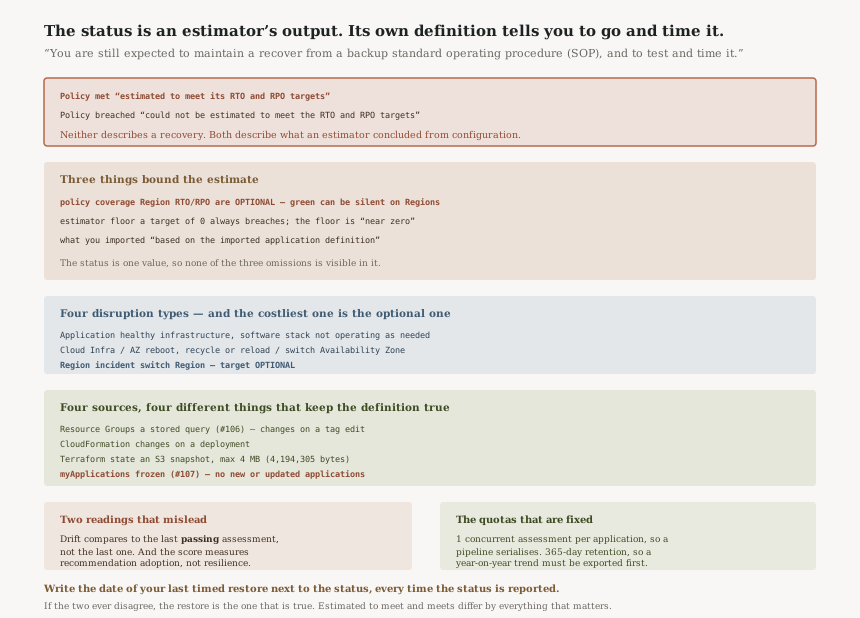
“The application is estimated to meet its RTO and RPO targets defined in the policy. All its components meet the defined policy objectives. For example, you selected an RTO and RPO target of 24 hours for disruptions across AWS Regions. AWS Resilience Hub can see that your backups are copied to your fallback Region. You are still expected to maintain a recover from a backup standard operating procedure (SOP), and to test and time it.”
That last sentence is inside the definition of the passing state. The service can see that backups are being copied; it cannot see whether anyone can restore from them inside 24 hours, and it says so rather than implying otherwise. What Policy met asserts is that your configuration is consistent with your target. What it does not assert is that the recovery works, or that anyone has ever performed it.
Even the testing path keeps the word. “Tests for SOPs measure estimated workload RTO and estimated workload RPO” — so a FIS experiment against an SOP produces a measured number that AWS still labels an estimate of the workload's objective, because one timed run of one procedure under one injected fault is evidence, not a guarantee.
FixTreat Policy met as a configuration review that passed, and record the date of the last timed restore separately. If those two facts live in the same report, the status stops being read as a recovery capability. The gap AWS names in the definition — test it and time it — is what converts an estimate into a number you can defend in an incident review.
A policy carries RTO and RPO per disruption type, and the types are not equally mandatory. The console walks you through application, infrastructure and Availability Zone values, and then:
“(Optional) If you have a multi-Region application and if you want to define a Region RTO and RPO, turn on Region - Optional.”
So the scope of Policy met is whatever disruption types your policy defines. An application with no Region targets can report Policy met while nothing has been estimated about a Region incident at all — and the status is a single value, so the omission is not visible in it.
This compounds with the defaults. “We have pre-populated a default RTO and RPO for your application”, which means a policy created quickly carries numbers nobody chose. A green status against a pre-populated target over three of four disruption types is a sentence with a lot of hidden qualifiers.
FixWrite the policy's coverage next to its status wherever it is reported: which disruption types carry targets, what the values are, and whether anyone chose them. Policy met is not a fact about an application; Policy met for application, infrastructure and AZ disruptions at a 24-hour RTO, with no Region target defined is one.
The estimate is explicitly a function of the definition: “the RTO that your application is estimated to meet based on the imported application definition and then run an assessment”. There are four resource collection sources, and they differ in ways that outlive the import.
Resource Groups is #106's object — a stored query whose membership is computed when something reads it. CloudFormation stacks change through deployments. Terraform state files are a snapshot in S3, so the definition is as current as the last state file you pointed at. And myApplications is the product #107 covered, which “no longer allows creation of new applications or updates of existing applications” — so that source can still be imported from, and can no longer change.
EKS is different again, and manual: “For AWS Resilience Hub to assess your Amazon EKS clusters, you must manually add the relevant namespaces to each of the Amazon EKS clusters”. A namespace you did not add is a namespace outside the assessment, and nothing in the compliance status distinguishes that from a namespace that passed.
FixRecord which source an application was defined from, because it determines what keeps the definition true. A stack-based definition drifts when someone deploys; a Resource Groups definition drifts when someone edits a tag; a Terraform definition drifts the moment the state file moves on. Drift detection catches resource additions and deletions, but it cannot tell you the question you asked was too narrow.
Architecture
Four statuses, and what each one actually asserts
| Status | AWS's definition | What it asserts |
|---|---|---|
| Policy met | “estimated to meet its RTO and RPO targets” | The configuration is consistent with the targets that were defined |
| Policy breached | “could not be estimated to meet the RTO and RPO targets” | The estimator could not get there — which includes the zero-target case below |
| Not assessed | “It's not currently assessed or tracked” | Nothing. Usefully explicit, unlike an absent result |
| Changes detected | “There is a new published version of the application that has not yet been assessed” | The last verdict describes an earlier version of the application |
Changes detected is the one worth wiring an alert to. It is the state where a status is still displayed and is no longer about the thing in front of you.
A target of zero is accepted and always fails
“AWS Resilience Hub allows you to enter a value zero in the RTO and RPO fields of your resiliency policy. But, while assessing your application, the lowest possible assessment result is near zero. Hence, if you enter a value zero in the RTO and RPO fields, the estimated workload RTO and estimated workload RPO results will be near zero and the Compliance status for your application will be set to Policy breached.”
This is the clearest available demonstration that the status is an estimator's output rather than a measurement. A zero RTO is an aggressive engineering goal; here it is an arithmetically unreachable one, because the estimator's floor is near zero and near zero exceeds zero. The breach reports a property of the comparison, not of the application.
Worth knowing before someone sets an aspirational zero in a policy and reads the resulting red status as a finding about the architecture.
The four disruption types, and which is optional
| Disruption type | AWS's description | Target required? |
|---|---|---|
| Application | “The infrastructure is healthy, but the application or software stack doesn't operate as needed” | Yes |
| Cloud Infrastructure | “resolved by rebooting, recycling, or reloading the faulty components” | Yes |
| AZ disruption | “resolved by switching to a different Availability Zone” | Yes |
| Region incident | “resolved by switching to a different AWS Region” | Optional |
Splitting the question four ways is the right design — an RTO for a bad deployment and an RTO for a Region incident are different engineering problems and should not share a number. The cost is that the compliance status collapses them back into one value, and the one that may be absent is the most expensive to get wrong.
Drift is measured against the last passing assessment
“For comparison, AWS Resilience Hub uses the previous assessment in which the application component met the policy.”
Not the previous assessment — the previous passing one. For a component that has been breaching for two months, policy drift is computed against a green state from before that, which is the right baseline for the question what changed when this broke and the wrong one for what changed since yesterday. Both are reasonable questions; only one is answered.
The resiliency score is not a resilience measurement
“AWS Resilience Hub generates a score that indicates how closely your application follows our recommendations for meeting the application's resiliency policy, alarms, standard operating procedures (SOPs), and tests.”
The score measures recommendation adoption. That is a reasonable thing to measure and a reasonable thing to improve, and it is not the same quantity as resilience — an application can follow every recommendation and still have an untested SOP, which is the specific gap the Policy met definition names. Reading the score as a resilience percentage is the second deflation in this post, and it is the one more likely to end up on a slide.
The quotas, and the one that paces everything
“Number of applications | Each supported Region: 50” and “Number of resources per application | Each supported Region: 400”, both adjustable — a documented ceiling of 20,000 assessed resources in one Region, with “Number of Application Components per application | Each supported Region: 200” grouping them.
The one that shapes practice is not adjustable: “Number of concurrent assessments per application | Each supported Region: 1”. One assessment at a time per application, so a pipeline that assesses on every change serialises against itself. The monthly allowance is generous by comparison — “Number of assessments per application per month | Each supported Region: 200”, which is 2,400 a year against a retention period of “365” days, also not adjustable. Assessment history older than a year is gone, so a year-on-year resilience trend has to be exported before it expires.
Also fixed at ten: “Number of Resiliency Policies | Each supported Region: 10”, adjustable, which is few enough that policies are shared across applications rather than written per application — worth knowing, because a shared policy means a shared definition of what Policy met meant.
One curiosity for anyone importing large state files: the Terraform ceiling is documented twice, as “The limit for Terraform state files is 4 megabytes (MB)” in the console flow and as “4,194,305” bytes in the quota table. The second is one byte above 4 MiB. If you are near the limit, trust the byte count.
Why This Architecture Holds Up
Saying estimated, every time, is the honest choice
The word appears in the status definitions, in the metric names, and even in the output of a timed FIS test. A service that reported RTO: 24 hours as a flat fact derived from configuration would be more satisfying to read and considerably more dangerous. Resilience Hub consistently declines to claim more than it knows, and the caveat inside Policy met is the strongest version of that.
Estimating from configuration is the only thing that scales
The alternative to an estimate is a test, and a test costs a disruption. Assessing 20,000 resources by actually failing them over is not a thing anyone will do on a schedule, so a configuration-derived estimate is what makes continuous assessment possible at all. The design is right; the reading of its output is where the risk sits.
FIS integration is the bridge, and it is in the right place
Recommending experiments that “Verify that recovery procedures, or standard operating procedures (SOPs), work correctly” is the service closing its own gap — the estimate tells you where to look, and the experiment tells you whether it works. An assessment tool that stopped at the estimate would leave the reader with no path from one to the other.
Key Architecture Decisions
| Decision | Choose this | Because |
|---|---|---|
| Reporting a compliance status | Report it with the policy's coverage and the date of the last timed restore | Policy met is an estimate from configuration, and its own definition asks you to test and time the SOP |
| Region RTO and RPO | Define them, or state explicitly that you have not | They are optional, and the status is one value that does not show the omission |
| Setting an aspirational zero target | Don't — use the smallest real number instead | The estimator's floor is near zero, so a zero target always returns Policy breached |
| Choosing an input source | Pick the one whose change mechanism you can see | A stack changes on deployment, a resource group on a tag edit, a Terraform state file whenever it is rewritten |
| Defining from myApplications | Treat it as frozen input | That product no longer accepts new applications or updates to existing ones |
| EKS applications | Enumerate namespaces deliberately and review the list | Namespaces are added manually, and an omitted one is simply outside the assessment |
| Assessing from a pipeline | Serialise, and export history before it ages out | One concurrent assessment per application, not adjustable, and 365-day retention, also not adjustable |
| Using the resiliency score as a target | Treat it as recommendation adoption, not resilience | That is what AWS says it measures |
The audit worth running
Open your policies and check whether Region targets are set. There are at most ten of them per Region by default, so this is a short list. Any policy without Region values is one whose green status says nothing about a Region incident, and that is usually the disruption the policy was created for.
Then find the date of the last timed restore for each application reporting Policy met. If no such date exists, the status is a configuration review and should be described as one. This is the check the Policy met definition is explicitly asking for.
Finally, look for applications sitting in Changes detected. That status means a published version has not been assessed, so whatever verdict is on screen describes a previous version. Of the four, it is the one whose problem is staleness rather than scope: Policy met misleads when it is read as a recovery capability, but it is at least about the application in front of you. Changes detected is not.
Closing Thought
The thread through this run has been instruments whose output is narrower than it reads. A tag policy that cannot require a tag. An index that answers partially and completely in the same format. A group that is a question rather than a set. An application that was a tag with an ARN in it.
This one is the most carefully labelled of them and still the easiest to misread, because the label is a single word in the middle of a sentence. Estimated to meet and meets differ by everything that matters in an incident, and only one of them is what a dashboard shows. AWS put the remedy inside the definition of its own passing status — test it, and time it — which is as clear as a vendor can reasonably be about the limits of what it can tell you.
So the practical ending is small and it is not a configuration change: write the date of your last timed restore next to the status, every time the status is reported. If the two ever disagree, the restore is the one that is true.
Reliability — AWS Fault Injection Service: what an experiment template commits you to, how stop conditions bound the blast radius, and why an experiment that completed without tripping an alarm is two different findings depending on what the alarm was watching.
Official AWS Reference
- AWS Resilience Hub concepts — the RTO and RPO definitions, estimated workload RTO and RPO as functions of the imported application definition, all four compliance statuses including the testing obligation inside Policy met, drift measured against the previous passing assessment, the resiliency score as recommendation adoption, AppComponents as resources that fail as a unit, and the four disruption types
- Set RTO and RPO — that RTO and RPO are entered per disruption type, that Region values are optional, that defaults are pre-populated, and that a zero target yields a near-zero estimate and therefore Policy breached
- Add resource collections — the four resource collection sources, cross-account and cross-Region import by ARN, the 4 MB Terraform state file limit and version 0.12 minimum, and the requirement to add EKS namespaces manually
- AWS Resilience Hub endpoints and quotas — 50 applications and 10 resiliency policies per Region, 400 resources and 200 Application Components per application, 200 assessments per application per month, the non-adjustable single concurrent assessment per application, the non-adjustable 365-day assessment retention, and the 4,194,305-byte Terraform state file ceiling
- myApplications availability change — that the product no longer allows creating new applications or updating existing ones, which is what makes it a frozen input source here
- What is AWS Resilience Hub? — the service overview and its FIS experiment integration; no figures in this post are drawn from it
Comments