Business Challenge
#66 ended on the thing nobody writes: an answer key. This post is about the services that ship with one.
Ask a foundation model to extract the line items from an invoice and it will. Ask it about a blank page, a rotated scan, a 400-page PDF or a language it was barely trained on, and it will still produce something. That is the difference being discussed here, and it is not about accuracy.
Textract's set quotas — the ones that “cannot be changed” — contain this: “For synchronous operations, JPEG, PNG, PDF, and TIFF files have a limit of 10 MB in memory. PDF and TIFF files also have a limit of 1 page.”
One page. Asynchronous accepts “500 MB in memory and a limit of 3,000 pages” — fifty times the size — but asynchronous means an S3 bucket, a job id, an SNS topic and polling.
So the question “will our documents ever be more than one page” decides whether you have an API call or a pipeline. It is answerable on day one and expensive to discover on day thirty.
FixEstablish the page count before the design, not during it. The limit is not negotiable.
Comprehend's real-time quota for “detecting entities, key-phrases, or dominant language” is 100 KB. For “detecting sentiment, targeted sentiment, and syntax” it is 5 KB.
Twenty times smaller, same service, same SDK, no difference in the call shape. A document that entity-detection accepts will be rejected by sentiment analysis.
Rekognition has the same pattern in a different dimension: “Maximum image size stored as an Amazon S3 object is limited to 15 MB” but “The maximum images size as raw bytes passed in as parameter to an API is 5 MB.” Same image, three times the allowance, depending only on whether you pass a pointer or the pixels.
FixRead the quota for the operation you are calling, not for the service.
A Comprehend custom endpoint scales in inference units, and one unit gives “Maximum throughput per inference unit (characters): 100/second” and “Maximum throughput per inference unit (documents): 2/second.”
Those two ceilings meet at 50 characters per document. Anything longer than a short sentence is limited by the character rate, not the document rate — so “2 documents per second” is the optimistic number and almost never the binding one.
With “a maximum of 50 inference units per endpoint”, a single endpoint tops out around 5,000 characters per second. That is a real constraint, and it is published rather than discovered.
FixSize on characters per second. The document rate is the wrong unit above a sentence.
Architecture
The useful way to read these three is as published contracts rather than as capabilities.
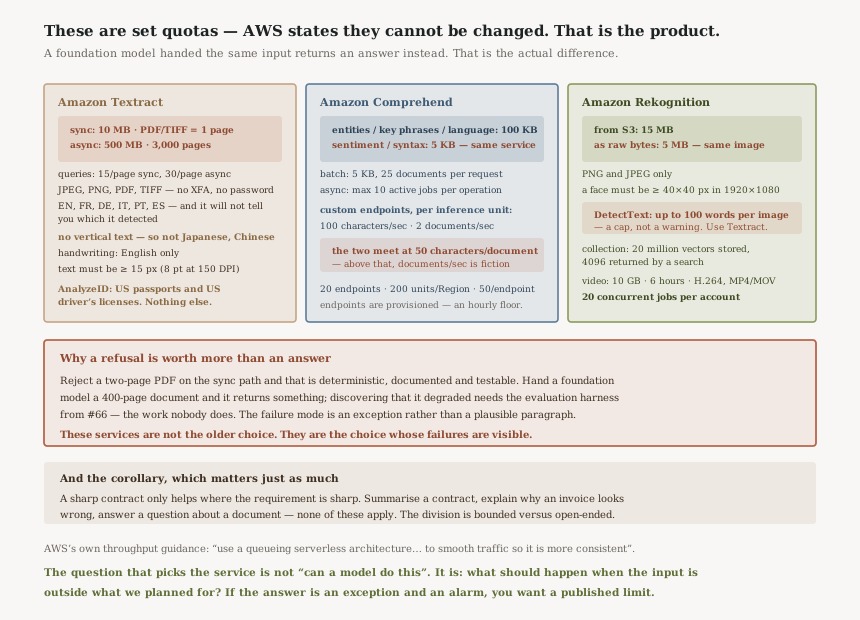
The limits describe the training data
Textract's language list is the clearest example: “English, French, German, Italian, Portuguese, and Spanish”, and more pointedly, “Amazon Textract does not support vertical text (text written vertically, as is common in languages like Japanese and Chinese) alignment within the document.”
Handwriting narrows further — “only supported in English” — and queries narrow again: “Query detection is only available in English document detection.” Three concentric circles, each smaller than the last, all published.
The sharpest of all is AnalyzeID, which “only supports US
passports, and US driver's licenses.” Not “works best with”. A service that names
two document types from one country is telling you precisely what it was built on, and a foundation model
asked to parse a Portuguese identity card will return a confident structure either way.
“DetectText can detect up to 100 words in an image.” Not an error, not a truncation warning — a cap. Photograph a page of text and you get a hundred words of it. The failure is silent, the response is well-formed, and the missing words look exactly like words the model failed to read. If the job is a page of prose, that is Textract's job, not Rekognition's, and the 100-word line is where the two services divide.
Where the ceilings actually bind
Rekognition's face collections hold “20 million” face vectors, but “The maximum matching face vectors the search API returns is 4096.” Storage is generous; a single answer is bounded — the same shape as the S3 Vectors top-K pagination split in #63.
Video is bounded twice over: “up to 10GB in size” and “up to 6 hours in length”, with “a maximum of 20 concurrent jobs per account” and a codec requirement — “must be encoded using the H.264 codec. The supported file formats are MPEG-4 and MOV.” Twenty concurrent jobs is the number that shapes a backlog, and it is per account rather than per bucket or per Region.
Comprehend's async side caps at “a maximum of 10 active jobs” per operation. Both of those are queue-depth constraints wearing quota clothing.
Why This Architecture Holds Up
A refusal is a testable contract
This is the argument for the whole category. When Textract rejects a two-page PDF on the synchronous path, that is a deterministic, documented, reproducible behaviour you can write a test against. When a foundation model is handed a 400-page document that exceeds what it can usefully attend to, it returns an answer, and finding out that the answer degraded requires the evaluation work from #66 — the work nobody does.
That inverts the usual framing. The task-shaped service is not the conservative choice because it is older. It is the conservative choice because its failure mode is an exception rather than a plausible paragraph.
Everything above is an argument for using them on bounded tasks — this field from this form, these labels from this image, this sentiment from this review. A sharp contract is only an advantage where the requirement is sharp. Asked to summarise a contract, explain why an invoice looks wrong, or answer a question about a document, none of these services applies at all, and reaching for one because it feels safer is how you end up building a foundation model badly out of API calls. The division is not old versus new. It is bounded versus open-ended.
Cost follows the shape too
These services bill per unit of work — a page, an image, a document — which makes the cost of a pipeline computable in advance from a volume estimate. #62 showed what it takes to do that on Bedrock: a quota measured in tokens, a burndown multiplier that differs per model, and a break-even that cannot be derived from public figures.
There is one exception to watch. Comprehend custom endpoints are provisioned, billed in inference units, so they carry the same shape as Provisioned Throughput — an hourly floor under a workload whether or not it runs. The built-in synchronous APIs do not.
Throttling is expected, and AWS says what to do about it
Rekognition's guidance is unusually direct: “Spiky traffic affects throughput. To get maximum throughput for the allotted transactions per second (TPS), use a queueing serverless architecture or another mechanism to 'smooth' traffic so it is more consistent.”
Read that as a design instruction rather than a troubleshooting note. The recommended architecture for these services is a queue in front of them, which means the asynchronous shape Textract forces on you at two pages is the shape you probably wanted anyway once volume is real.
Key Architecture Decisions
| Decision | Choice | Reasoning |
|---|---|---|
| Task-shaped or foundation model | Bounded task → task-shaped | A documented refusal beats a plausible answer when the requirement is sharp. |
| Textract sync or async | Decided by page count, on day one | Synchronous PDF is one page, and the limit cannot be raised. |
| Comprehend document size | Check per operation | 100 KB for entities, 5 KB for sentiment — same service, twentyfold gap. |
| Comprehend capacity | Size in characters per second | The two ceilings cross at 50 characters; above that the document rate is fiction. |
| Rekognition image transfer | Via S3, not raw bytes | 15 MB against 5 MB, for the identical image. |
| Text in images | Textract, not Rekognition DetectText | DetectText caps at 100 words and does not say it truncated. |
| Non-Latin or vertical scripts | Not Textract | Vertical text is unsupported, and handwriting is English only. |
| Traffic shape | Queue in front, always | AWS's own throughput guidance, and the async path already assumes it. |
The question that picks the service
Not “can a model do this” — it usually can. Ask instead: what should happen when the input is outside what we planned for?
If the right answer is an exception, a retry queue and an alarm, you want a service with a published limit. If the right answer is a best effort on unpredictable input, you want a model and you have accepted that you now owe an evaluation harness. Both are legitimate. Choosing the second by accident, because it demoed well on a clean sample, is the mistake.
Closing Thought
There is a reading of this block — posts 61 through 66 — where every one ends at the same problem: the system will produce output regardless, and knowing whether the output is right requires work that nothing forces you to do. Chunking, vector stores, guardrails, evaluation. Four different subjects, one recurring shape.
The task-shaped services are the counterexample, and that is why they are worth a post rather than a footnote. Textract will not read a second page synchronously. Comprehend will not take 6 KB for sentiment. Rekognition will not return a 4097th match. Each of those is a sentence in the documentation and an exception in your logs, and neither requires you to have built anything to discover it.
That is not nostalgia for narrow APIs. It is the observation that a system which can refuse is a system you can reason about — and on the subset of problems that are genuinely bounded, that property is worth more than the flexibility you would be trading it for.
AI & ML — inference endpoints: real-time, serverless, batch and async, and how to choose between them when the payload size and the latency budget disagree.
Official AWS Reference
- Set Quotas in Amazon Textract — the one-page synchronous limit, language and handwriting support, and the AnalyzeID scope
- Guidelines and quotas for Amazon Comprehend — per-operation document sizes, inference-unit throughput and custom model limits
- Guidelines and quotas in Amazon Rekognition — image and video ceilings, collection sizes, and the TPS smoothing guidance
Comments