Business Challenge
#91 established what a private endpoint is: a network interface in your subnet holding an address out of your own range, standing in for a service. #93 established that this is a change of destination. What neither covered is the part that actually decides whether any of it works.
“The FQDN of the service automatically resolves to a public IP address. To resolve to the private IP address of the private endpoint, change your DNS configuration.”
So a correctly deployed, approved, reachable private endpoint carries no traffic at all until something else is true somewhere else. The network interface exists, the /32 route exists, and every client keeps going to the public address because that is what the name still says.
The marketing framing of this is genuinely accurate and genuinely misleading at once:
“Connection URLs for your existing applications don't change. Client DNS requests to a public DNS server resolve to your private endpoints. The process doesn't affect your existing applications.”
True, and it is why this feature is adoptable. It also means the only evidence that the design is working or broken lives in a subsystem that most application teams do not own, cannot see from the client, and will not be told about when it changes.
Architecture
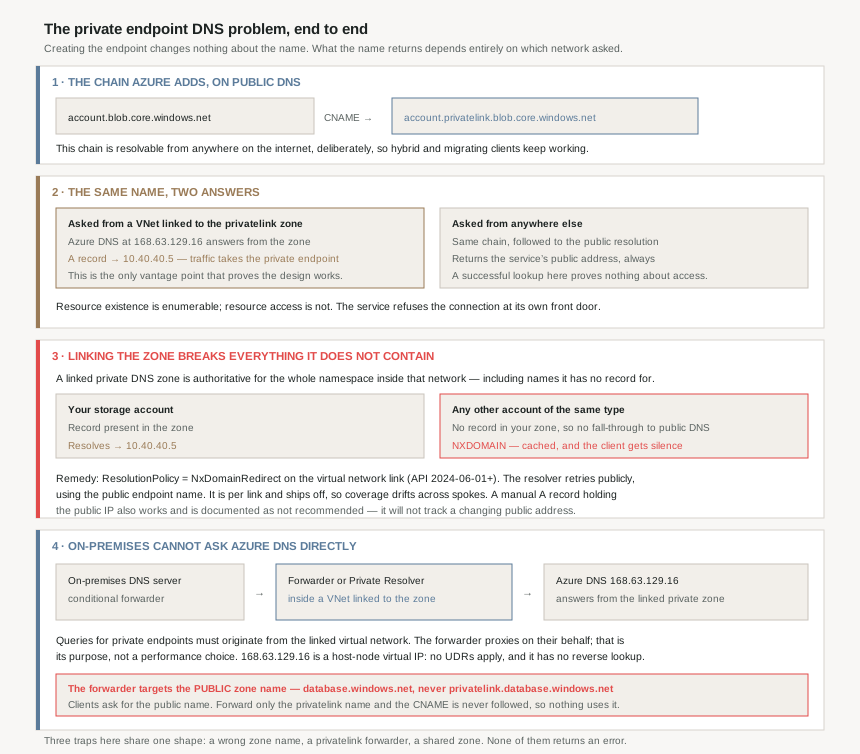
The chain, and why it is public on purpose
Azure does not rewrite the service's name. It adds a redirection in front of it: “Azure creates a canonical name DNS record (CNAME) on the public DNS. The CNAME record redirects the resolution to the private domain name.” So account.blob.core.windows.net becomes an alias for account.privatelink.blob.core.windows.net, and the question of what that second name resolves to is the entire subject of this post.
The first surprise is that the chain is deliberately world-readable.
“The CNAME chain in the public privatelink.<service>.<region>.<suffix> zone is deliberately resolvable from anywhere on the internet so that hybrid and gradual-migration scenarios continue to work without breaking existing clients. A successful public DNS lookup confirms only that a resource with that exact name exists in the global Azure namespace. It doesn't confirm that a private endpoint is attached, reveal the private endpoint's IP, or grant any data-plane access.”
That paragraph is doing something unusual for vendor documentation: it names a property that looks like an information leak, explains why it is deliberate, and then draws the line precisely. “Resource existence is enumerable; resource access is not.” Access is refused by the service, not by DNS — when public network access is Disabled “the service rejects the connection at the front door regardless of DNS resolution”.
This is worth having in hand before a security review asks why an internal storage account name resolves from a coffee shop. It resolves. It always will. That is not the control, and it was never meant to be.
The zone name is an API contract, not a convention
The long tables of recommended zone names read like a style guide. They are not.
“Private endpoint private DNS zone configurations will only automatically generate if you use the recommended naming scheme in the following tables.”
A zone named privatelink.blob.core.windows.net gets its A records written and maintained for it. A zone named anything else does not, and nothing reports that: you have a private DNS zone, a private endpoint, a zone group, and no record. The naming is matched, not interpreted.
| Service | Private DNS zone | Public forwarder |
|---|---|---|
| Storage — blob | privatelink.blob.core.windows.net | blob.core.windows.net |
| Azure SQL Database | privatelink.database.windows.net | database.windows.net |
| Azure Key Vault | privatelink.vaultcore.azure.net | vault.azure.net and vaultcore.azure.net |
Key Vault is the one to notice. One private zone serves two public names, and the private zone is named after the one applications rarely use. A team that reasons "the vault is at vault.azure.net, so the zone is privatelink.vault.azure.net" produces a zone that is syntactically plausible, accepted by Azure, and inert.
One zone per service, and what happens if you share
Storage is not one zone. It is one zone per subresource — blob, table, queue, file, web and dfs each have their own — which, combined with #91's rule that one endpoint serves one subresource, means a fully private storage account is six endpoints and six zones.
The temptation is to consolidate. The documentation forbids it, and the reason is worse than untidiness:
“Existing Private DNS Zones linked to a single Azure service should not be associated with two different Azure service Private Endpoints. This will cause a deletion of the initial A-record and result in resolution issues… Don't place records for multiple services in the same DNS zone.”
The second endpoint does not fail to register. It registers, and the first one's record goes away. So the symptom is that something which worked yesterday stopped, in a component nobody edited, at the moment an unrelated service was onboarded.
The zone group, and the service that sits exactly on its limit
The zone group is the machinery that keeps records correct: “a strong association between the private DNS zone and the private endpoint… when you delete the private endpoint, all the DNS records within the DNS zone group are deleted.” It replaced a generation of scripts that scraped the endpoint and wrote records by hand, and it is the right default.
It has three constraints that interact badly for exactly one service:
| Constraint | Value |
|---|---|
| DNS zones per zone group | Up to five |
| Private DNS zones per zone name, per group | Only one |
| Zone groups per private endpoint | More than one is not supported |
Azure Monitor's azuremonitor subresource requires privatelink.monitor.azure.com, privatelink.oms.opinsights.azure.com, privatelink.ods.opinsights.azure.com, privatelink.agentsvc.azure-automation.net and privatelink.blob.core.windows.net. That is five zones, into a group that holds five, on an endpoint that may have only one group. Azure Monitor does not approach the limit; it occupies it exactly, with nothing left for a sixth zone should one ever be added.
Why This Architecture Holds Up
Because linking the zone breaks resolution for everything you do not own
This is the failure that surprises people, and it is caused by the fix rather than by the problem. A private DNS zone linked to a virtual network is authoritative for that namespace inside it. Authoritative means it answers for names it does not have, and the answer is "no such name".
“Private networks using a Private DNS Zone for any given resource type… can only resolve DNS Queries to public resources/Public IPs if those public resources don't have any existing Private Endpoint Connections… Otherwise, the Private DNS Zone will respond to the DNS query with NXDOMAIN as no matching DNS record would be found in the Private DNS Zone.”
So the moment you link privatelink.blob.core.windows.net to a virtual network to make your storage account private, every workload in that network loses the ability to reach a partner's, a vendor's, or a public dataset's storage account that happens to have a private endpoint of its own somewhere else in the world. Nothing in your configuration refers to those accounts. You did not opt into deciding their fate.
And NXDOMAIN is a durable answer, not a transient one: “this negative answer typically prevents resolvers from retrying the query until the cached negative answer expires”, and “when a DNS resolver receives (or has cached) a negative response, it sends no DNS response to the DNS client and the query fails”. The client does not get an error it can interpret. It gets silence.
The native remedy is recent and worth knowing by name. ResolutionPolicy set to NxDomainRedirect, applied at the virtual network link level, available from API version 2024-06-01 or higher, surfaced in the portal as Enable fallback to internet. When an authoritative NXDOMAIN comes back for a private link zone, “the Azure recursive resolver retries the query… using the public endpoint QNAME as the query label”.
The documented demonstration is the clearest statement of the problem I have seen in Microsoft's own docs: two storage accounts, two identically named private DNS zones in different resource groups, one virtual network. Before the change, one account resolves to 10.40.40.5 and the other returns nothing at all. After the change, the second resolves out to the public chain and 203.0.113.161. Same query, same client, same minute — the only variable is a property on a link.
The property takes exactly two values, Default or NxDomainRedirect, and applies only to zones associated with Private Link resources. It is a per-link setting, which means in a hub-and-spoke estate it is a decision repeated once per spoke and easy to apply unevenly. The documentation supplies a Resource Graph query to find which links have it, which is a strong hint about how that tends to go.
Because the thing that resolves is not where the client is
Inside a virtual network with no custom DNS, resolution is straightforward: the client asks 168.63.129.16 and Azure DNS answers from the linked private zone. That address now makes its fourth appearance in this run of posts — the Load Balancer health probe source in #83, an addressing restriction in #88, a forbidden forwarding destination in #90, and here the thing that actually answers.
Its properties explain why hybrid DNS is hard rather than merely fiddly. It “is a virtual IP of the host node and as such it isn't subject to user defined routes”, its DNS traffic “isn't subject to the configured network security groups unless targeted using the AzurePlatformDNS service tag”, and it “doesn't support reverse DNS lookup”. It is a platform fixture, not a server you can route to, filter normally, or point an on-premises resolver at.
Which produces the constraint that shapes every hybrid design:
“DNS queries for private endpoints must originate from the virtual network that is linked to the private DNS zone. The DNS forwarder enables this by proxying queries on behalf of on-premises clients.”
So the forwarder is not a performance choice or an architectural preference. It is the only way an on-premises client can be given an answer that only exists inside a virtual network. The documented options are a virtual machine running DNS services, Azure Firewall acting as a DNS proxy, or an Azure Private Resolver — “an Azure managed service that can resolve DNS queries without the need for a virtual machine acting as a DNS forwarder”, which is the subject #90 covered in full.
Because the conditional forwarder points at the public name, and the mistake looks right
The documentation flags this twice, under Important both times, which is usually a sign of how often it goes wrong:
“The conditional forwarding must be made to the recommended public DNS zone forwarder. For example: database.windows.net instead of privatelink.database.windows.net.”
The instinct is exactly backwards, and defensibly so: the record you want is in the privatelink zone, so that is the zone you forward. But the client asks for the public name. Forwarding only the privatelink name means the original query never reaches Azure, so the CNAME that produces the privatelink name is never followed, and the forwarder you built is never consulted for the question anyone is actually asking.
This is the same shape as the zone-name trap earlier: a configuration that is internally coherent, accepted without complaint, and wired to a name nothing queries.
Because one zone for many networks is a requirement, not a preference
In hub-and-spoke — which is to say, in almost every estate — the guidance is to build the zone once and link it widely:
“A single private DNS zone is required for this configuration. Creating multiple zones with the same name for different virtual networks would need manual operations to merge the DNS records.” And explicitly across subscription boundaries: “link the same private DNS zones to all spokes and hub virtual networks that contain clients that need DNS resolution from the zones”.
That makes the private DNS zone a shared, central, cross-subscription resource owned by the platform team — which collides with the way private endpoints are usually created, by application teams, in their own resource groups, often through a module that offers to make a zone for them. Two identically named zones in two resource groups is precisely the fallback demonstration's setup, and it is what application-team autonomy produces by default.
The ceilings are generous enough that centralising is not the constraint: 1000 private DNS zones per subscription, 1000 virtual network links per zone, and a virtual network may link to 1000 zones. Autoregistration is the exception that binds — 100 links per zone, and a virtual network may use it for only 1 zone — but autoregistration is for virtual machine names, not for private endpoints, so it does not apply to this design at all.
| Limit | Value |
|---|---|
| Private DNS zones per subscription | 1000 |
| Record sets per private DNS zone | 25000 |
| Records per record set | 20 |
| Derived: records in one zone | 25,000 × 20 = 500,000 |
| Virtual network links per private DNS zone | 1000 |
| Private DNS zones a virtual network can link to | 1000 |
| Derived: link relationships per subscription's zones | 1000 × 1000 = 1,000,000 |
| Links per zone with autoregistration | 100 |
| Zones a virtual network may autoregister into | 1 |
Because the resolver has a per-machine ceiling, and DNS is now on the data path
Making a dependency private moves its name resolution from "cached public answer" to "query a zone". The per-virtual-machine ceiling is therefore worth knowing before a fleet grows into it: a virtual machine may send 1000 DNS queries per second to the Azure DNS resolver, with a maximum of 200 queued pending response — a queue holding 0.2 seconds of peak rate. Past that, queries are not slow; they are dropped, and the application sees a name that failed to resolve.
For scale beyond that, the Private Resolver endpoint is rated at 10,000 QPS, ten times a single virtual machine's permitted rate, with 5 inbound and 5 outbound endpoints per resolver and 1000 forwarding rules per ruleset. A virtual machine acting as a DNS forwarder has no such published rating, which is its own argument.
Key Architecture Decisions
| Decision | Choice | Why |
|---|---|---|
| Who owns private DNS zones | The platform team, centrally, one zone per service type | A single zone is required for peered and hub-and-spoke resolution; duplicates with the same name need manual record merging and are what per-team automation produces by default. |
| Zone naming | Copy the documented name exactly, including Key Vault's vaultcore |
Record automation only triggers on the recommended name. A plausible wrong name is accepted and produces a zone that is never populated. |
| Consolidating services into one zone | Never | Associating one zone with two services' private endpoints deletes the first A-record, so an unrelated onboarding breaks a working service. |
| Fallback to internet on virtual network links | Enable deliberately, and audit which links have it | A linked zone returns NXDOMAIN for every resource of that type it has no record for, including third-party ones. NxDomainRedirect needs API 2024-06-01+ and is set per link, so coverage drifts. |
| Manual A records holding public IPs | Avoid | Documented as not recommended: the record won't track the public IP if it changes, so it fails later, silently, for a reason unrelated to any change you made. |
| On-premises resolution path | Forwarder or Private Resolver inside a linked virtual network | Queries for private endpoints must originate from the linked virtual network, and 168.63.129.16 is a host-node virtual IP, not a resolver on-premises can address. |
| Conditional forwarder target | The public zone name, never the privatelink name |
Clients query the public name; forwarding only the privatelink name means the CNAME is never followed and the forwarder is never used. |
| Azure Monitor private endpoints | Plan the zone group as full on day one | Its five required zones exactly occupy the five-zone group limit, and a second zone group per endpoint is not supported. |
| Treating public resolvability as a leak | Document it as intended, control access at the service | The public CNAME chain is deliberately resolvable worldwide; existence is enumerable, access is refused by the service when public network access is disabled. |
| DNS capacity for a privatised estate | Size against 1000 queries per second per virtual machine | Only 200 queries may be queued per machine. Beyond the ceiling queries are dropped, which presents as resolution failure rather than latency. |
| Verifying the endpoint works | Resolve the name from inside the consuming network | A lookup from anywhere else follows the same chain to the public answer, so a successful resolution outside the network proves nothing about the private path. |
Closing Thought
Every other part of a private endpoint deployment is declarative and verifiable. The subnet exists or it does not. The connection is Approved or Pending. The network interface has an address. DNS is the only component where the correct configuration and the broken one look identical from the resource graph, and where the evidence of which you have depends on the vantage point of whoever is asking.
That is why three separate traps in this post share one shape — a wrong zone name, a privatelink conditional forwarder, a second service sharing a zone. None of them produces an error. Each is accepted, stored, and rendered in the portal looking exactly like the version that works. The failure arrives later, in a different component, usually to a team that changed nothing.
Linking a private DNS zone silently takes responsibility for every resource of that type on the planet, because authority over a namespace is not divisible by ownership. Your zone now answers for a vendor's storage account you have never heard of, and the answer is "it does not exist". NxDomainRedirect exists because that is not a defensible default — but it ships off, per link, and has to be chosen.
The practical consequence is that the DNS design has to be settled before the first private endpoint is created, not after the first one fails. Retrofitting a central zone across spokes that each built their own means merging records by hand, in the one component where a merge error is invisible until something cannot resolve.
Official Azure Reference
- Azure Private Endpoint private DNS zone values — the public CNAME behaviour, the enumerable-not-accessible statement, the recommended zone name tables, the automatic-generation requirement, the NXDOMAIN caution and the zone-sharing A-record deletion
- Azure Private Endpoint DNS integration scenarios — the six resolution scenarios, the single-zone requirement for peered and hub-and-spoke designs, the forwarder-must-be-inside rule, the public-name conditional forwarder, and the DNS zone group and its limits
- Fallback to internet for Azure Private DNS zones — the
ResolutionPolicyproperty,NxDomainRedirect, the API version, the two permitted values, and the before-and-after resolution demonstration - Azure IP address 168.63.129.16 — what it is, that it is unchanged across all regions and national clouds, that it is not subject to user-defined routes, its NSG and service-tag behaviour, and that it supports no reverse lookup
- Azure subscription and service limits — the private DNS zone, record set, virtual network link and autoregistration limits, the per-virtual-machine resolver query and queue ceilings, and the DNS Private Resolver limits
- Virtual network links for private DNS zones — the link object the resolution policy is set on, for further reading (no claims drawn from it)
- Azure Firewall DNS settings — Azure Firewall as the managed DNS proxy option, for further reading (no claims drawn from it)
Comments